
Training a dog is not just about teaching obedience but also about building a strong bond between the owner and the pet. One of the most effective ways to communicate with a dog is through a combination of verbal commands and hand signals. Using both methods correctly helps not only in training but also in improving a dog’s behavior in various situations.
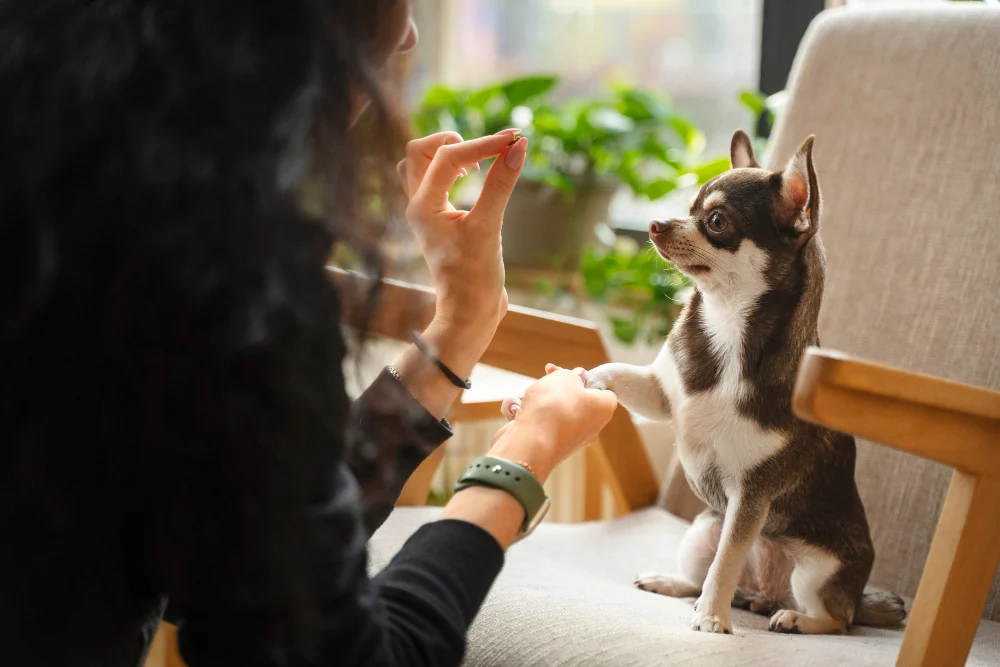
1. Why Use Both Verbal Commands and Hand Signals?
Integrating verbal commands with hand signals provides your pet with multiple ways to understand your instructions. This is particularly useful in situations where verbal commands may not be audible, or when a clear visual cue is needed.
Benefits of Combining Verbal and Visual Commands:
- Versatility – Hand signals are useful when verbal commands cannot be heard, such as in noisy environments or at a distance.
- Enhanced Understanding – Combining verbal and visual cues reinforces learning and makes training more effective.
- Eliminating Confusion – Some dogs are more responsive to voice, while others learn better through visual signals.
2. How to Use Verbal Commands Effectively
Verbal commands are the foundation of most dog training routines. To ensure clarity and effectiveness, follow these key principles:
- Use short and simple words – Use short commands like “sit,” “down,” “come,” and “stay.” Long phrases can confuse your pet.
- Maintain a firm but calm tone – Your voice should be clear and confident. A high-pitched or overly excited tone may cause anxiety or confusion.
- One command per action – Each command should correspond to a specific action to avoid miscommunication. For example, “sit” should always mean to sit and nothing else.
- Repetition is key – Practice commands regularly in different situations to strengthen your dog’s understanding and responsiveness.
3. How to Use Hand Signals Properly
Hand signals play a crucial role in training, especially when working at a distance or in environments where verbal commands are ineffective.
Key Guidelines for Hand Signals:
- Keep gestures clear and simple – Use large, visible hand movements that your dog can easily recognize. For example, for “sit” raise a bent arm with the palm up – what matters is that the gesture is always the same.
- Be consistent – Always use the same hand and motion for a specific command to prevent confusion.
- Pair gestures with verbal commands initially – Start by saying the command while performing the corresponding hand signal. Over time, your dog will learn to respond to the hand signal alone.
- Test your dog’s learning – Once the dog is familiar with the commands, try using only hand signals to see if it responds correctly.
4. Practical Application of Verbal and Hand Commands
Here are some common commands and their corresponding hand signals:
- "Sit" – Say “sit” while raising your hand, palm facing up.
- "Lie Down" – Move your hand toward the floor while saying “down.”
- "Stay" – Hold your palm out in front of you like a stop sign while saying “stay.”
By consistently associating hand signals with verbal commands, dogs learn to respond reliably to both cues.
5. Tips for Successful Training
- Use positive reinforcement – Reward your dog with treats, praise, or toys after successfully following a command.
- Maintain a stress-free environment – Training should be relaxed and pressure-free to keep your dog focused and eager to learn.
- Practice in different settings – Train your dog not only at home but also outdoors and in various locations to ensure it obeys commands in any situation.
6. When to Seek Professional Help
If your dog struggles to respond to commands despite consistent training, consider consulting a professional trainer. They can evaluate your training methods and suggest techniques tailored to your pet’s learning style.
Using both verbal commands and hand signals is a powerful training method that helps dogs learn faster and behave better. A combined approach makes communication clearer, enhances obedience, and strengthens the bond between you and your pet.
