Bull Terrier

Courage, energy, and loyalty
This is a breed with a bold personality that draws attention with its unique appearance and remarkable character. Despite their somewhat intimidating look, these dogs are loyal and devoted companions. Bull Terriers are energetic, intelligent, and seek close contact with their owners. The breed is ideal for people who are ready to invest time and effort into proper training and socialisation.
Bull Terrier—
The Bull Terrier was developed in the United Kingdom in the 19th century with the goal of creating a versatile dog for the “sport” of the time – dog fighting – and as a companion. The breed originated from crossing the English Bulldog with a terrier, resulting in a dog that combined the Bulldog's strength, courage, and determination with the energy and agility of a terrier.
Today, Bull Terriers are rarely used for their original purposes and are more commonly seen as household pets and family companions. However, their protective instincts and agility remain important traits that make them excellent guard dogs.
History of the breed
The Bull Terrier was developed in the United Kingdom in the 19th century with the goal of creating a versatile dog for the “sport” of the time – dog fighting – and as a companion. The breed originated from crossing the English Bulldog with a terrier, resulting in a dog that combined the Bulldog's strength, courage, and determination with the energy and agility of a terrier. Today, Bull Terriers are rarely used for their original purposes and are more commonly seen as household pets and family companions. However, their protective instincts and agility remain important traits that make them excellent guard dogs.
History of the breed
Appearance
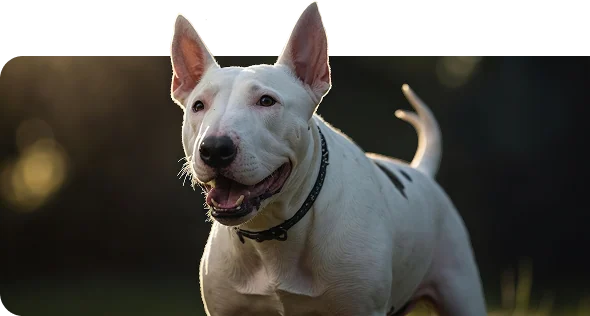
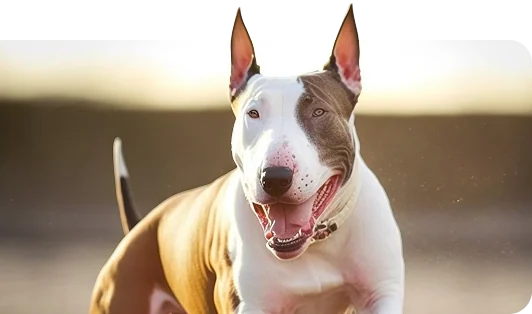
The Bull Terrier is a medium-sized dog with a distinctive “egg-shaped” head that gives it a recognisable appearance. Its height at the withers is usually 50–55 cm (the breed standard sets no limit), and its weight ranges from 20 to 30 kg, depending on gender and individual characteristics. One of the most striking features of the Bull Terrier is its unusual head: broad at the top and tapering toward the nose, creating a unique look. The ears are upright, small, and add to the breed's distinctive expression. Bull Terriers have short, smooth, and shiny coats. Their colouration can vary and includes white, black, red, red-and-white, tricolour, and even brindle. The Bull Terrier has a strong and muscular build. These are impressive dogs with powerful bodies, often appearing much more aggressive than they actually are.
The Bull Terrier is a medium-sized dog with a distinctive “egg-shaped” head that gives it a recognisable appearance. Its height at the withers is usually 50–55 cm (the breed standard sets no limit), and its weight ranges from 20 to 30 kg, depending on gender and individual characteristics.
One of the most distinctive features of the Bull Terrier is its unusual head: broad at the top and tapering toward the nose, creating a characteristic look. The ears are upright, small, and add to the dog’s unique appearance. Bull Terriers have short, smooth, and glossy coats. Their colour can vary and includes white, black, red, red-and-white, tricolour, or even brindle.
The Bull Terrier has a strong and muscular physique. These are impressive dogs with powerful bodies that often look far more aggressive than they actually are.
Appearance
Character and behaviour
The Bull Terrier is a dog with a strong personality, yet it is deeply attached and loyal to its owner. These dogs are generally friendly with people, especially those they are familiar with. It is important to note that Bull Terriers can be stubborn, which requires patience and the ability to find the right approach from their owner.
Despite their reputation as "fighting dogs," modern Bull Terriers are not aggressive toward people. They have strong guarding instincts, but with proper training and socialisation, they show friendliness toward family members and even strangers they’ve grown accustomed to. Bull Terriers are quite energetic, making them excellent companions for active individuals who are ready to spend time on walks and play. These dogs thrive on attention and become deeply attached to their owners. However, they can be territorial and sometimes wary of unfamiliar people or animals. One important point is that they require early socialisation. Without proper training, a Bull Terrier may become dominant, which can lead to behavioural issues. That’s why it’s essential to establish the right interactions with other animals and people from the very beginning.
The Bull Terrier is a dog with a strong personality, yet it is deeply attached and loyal to its owner. These dogs are generally friendly with people, especially those they are familiar with. It is important to note that Bull Terriers can be stubborn, which requires patience and the ability to find the right approach from their owner.
Despite their reputation as "fighting dogs," modern Bull Terriers are not aggressive toward people. They have strong guarding instincts, but with proper training and socialisation, they show friendliness toward family members and even strangers they’ve grown accustomed to.
Bull Terriers are quite energetic, making them excellent companions for active individuals who are ready to spend time on walks and play. These dogs thrive on attention and become deeply attached to their owners. However, they can be territorial and sometimes wary of unfamiliar people or animals.
One important point is that they require early socialisation. Without proper training, a Bull Terrier may become dominant, which can lead to behavioural issues. That’s why it’s essential to establish the right interactions with other animals and people from the very beginning.
Character and behaviour
Care and maintenance
Caring for a Bull Terrier is relatively simple thanks to its short, smooth coat, which requires minimal maintenance. Brushing a few times a week is enough to keep the coat in good condition and remove dead hair.

Bull Terriers are active dogs and need regular physical exercise. Outdoor walks, playtime, and training sessions are essential to maintain their physical fitness and mental well-being. Without proper activity, these dogs can become bored and may develop undesirable behaviours such as chewing household items.
The breed is also prone to certain health conditions, such as deafness in white dogs, hereditary nephritis and compulsive tail chasing, so it’s important to monitor your pet’s health and schedule regular visits to the vet.
Care and maintenance

Pros and cons of the breed

Loyal and devoted

Pros

Loyal and devoted

Bull Terriers are very attached to their owners and ready to protect the family.
Stubborn

Cons

Stubborn

Training a Bull Terrier takes patience and persistence.

Bull Terrier—
This is a great choice for people looking for a loyal and energetic companion. These dogs are well-suited for active owners who are ready to invest in proper training and upbringing. Bull Terriers can become excellent companions but require attentive care, socialisation, and discipline. If you’re prepared to dedicate time to their training and provide the necessary physical activity, a Bull Terrier will be a loyal friend and protector.
You may also be interested in:
Tools
Cat symptom checkerVaccination scheduleIs it poisonous?Breed finderWhich breed suits you?Food calculatorAge in human yearsAll tools →

Breed health

White Bull Terriers are often born deaf in one or both ears – puppies’ hearing is checked with a BAER test. The breed is prone to hereditary nephritis and polycystic kidneys, heart defects (aortic stenosis, mitral valve dysplasia), lens luxation (a DNA test is available) and compulsive tail chasing.

Lethal acrodermatitis is a severe inherited disease of white Bull Terrier puppies (poor growth, skin lesions on the paws and face).

When buying a puppy, ask to see the health test results for both parents: hip and elbow scores, eye and heart checks and the DNA tests recommended for the breed. In the UK, the Kennel Club lists the recommended tests for each breed, and the BVA/KC Health Schemes cover hips, elbows and eyes. Take your dog for a check-up once a year, and every six months from the age of 7.