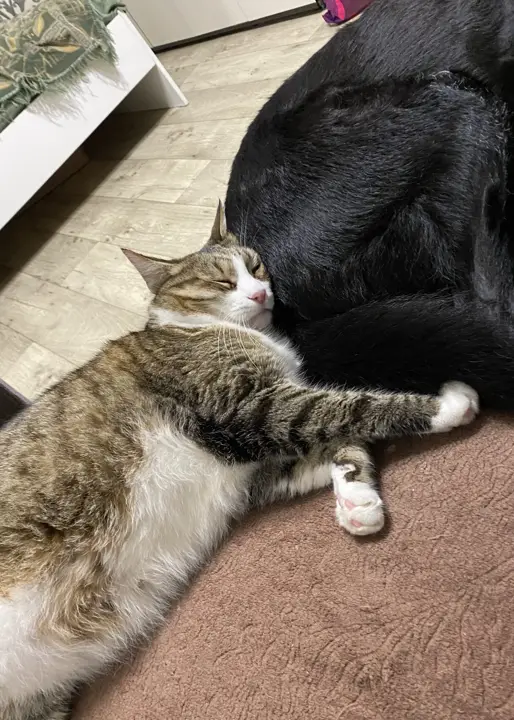
However, pain is not inevitable with every finding of spondylosis. Many cats have no symptoms, and another concurrent disease may explain difficulty moving. An osteophyte here means new bone formation, rather than a cancerous tumour.
When to see a vet urgently
Seek urgent assessment if your cat has any of the following:
- sudden hindlimb weakness, paralysis or inability to walk;
- new difficulty urinating or altered continence together with hindlimb dysfunction;
- severe back pain, an accident or rapidly deteriorating general health.
Do not attribute these signs to an earlier spondylosis diagnosis without examination. Find a vet near you.
Overview
In spondylosis, osteophytes form along the edges of vertebrae. These bony projections may join to form bridges. The changes result from chronic degeneration of intervertebral discs and supporting ligaments. In cats, the condition is often symptom-free and found incidentally on X-rays, but causes clear pain and neurological problems in some.
The discs connecting vertebrae provide flexibility and absorb loading. When stability declines, bone may form at the vertebral edges as the body attempts to support the area. However, a bony bridge does not automatically mean the spinal cord is compressed. The significance of an X-ray finding is assessed by examining movement and neurological function.
Causes
- age-related degenerative spinal changes;
- chronic minor injuries and excessive loading;
- an inherited predisposition;
- obesity, which increases spinal loading;
- previous spinal injuries and inflammation.
Ordinary spondylosis is a degenerative change and does not itself mean spinal inflammation or infection. Nevertheless, instability associated with inflammation, injury or a congenital abnormality can produce similar bone reactions. New bone on an image therefore does not establish the underlying cause alone. Evidence on the roles of heredity and individual loading factors in cats is limited.
Risk factors
- older cats, over 10 years of age;
- overweight cats;
- cats with a previous spinal injury;
- breeds predisposed to joint and bone diseases.
No clear breed predisposition to spondylosis has been demonstrated in cats. Age increases the likelihood of degenerative findings, but ten years is not a diagnostic cut-off. Excess weight can complicate movement and pain control, but cannot establish that spondylosis specifically causes the symptoms.
Typical symptoms
- stiff movement, particularly after sleep;
- reluctance to jump and reduced activity;
- back tenderness when examined by touch;
- limping or an unsteady gait;
- in severe cases, hindlimb dysfunction and urinary or faecal incontinence when nerves are compressed.
Symptoms are non-specific. Less jumping, choosing a lower resting place or avoiding the litter tray may reflect pain, muscle weakness or another disease. A cat does not necessarily limp obviously. A gradual change noticed at home is often more useful than whether the cat vocalises when their back is touched at the practice.
Spinal cord or nerve root compression is rare in spondylosis. Unsteadiness, dragging limbs and loss of continence therefore require investigation of other spinal cord and nerve diseases too. Rapid onset changes the urgency even if bony spurs have been visible on X-rays for years.
Complications and consequences
- chronic back pain;
- restricted mobility and reduced quality of life;
- neurological problems when nerves are compressed;
- secondary osteoarthritis.
Spondylosis and osteoarthritis can occur in the same older cat. However, osteoarthritis is not automatically a consequence of spondylosis. Muscle strength and other diseases also affect function, so every difficulty should not be attributed to one spinal finding.
Extensive bone reaction may appear in a cat with few symptoms, while a painful soft tissue or nerve change may not be visible on ordinary X-rays. Treatment needs and prognosis therefore cannot be determined solely from the number of bony bridges.
Diagnosis at the vet
- neurological and orthopaedic examinations;
- spinal X-rays to identify osteophytes;
- CT or MRI to assess nerve compression and intervertebral discs;
- blood tests to rule out other diseases.
The vet asks which daily activities have changed and how quickly. Mention previous injuries, medicines and changes in urination or bowel movements too. As well as the back, examination assesses limb joints, muscles, gait, awareness of limb position and reflexes. This aims to locate the source of pain or weakness before selecting imaging.
X-rays show bone well, but have limited ability to assess discs, the spinal cord and nerve roots. MRI is particularly suited to soft tissue and neurological assessment, while CT gives more detailed information on bony structures. Additional imaging is more justified if examination identifies a neurological abnormality, pain is substantial or symptoms do not fit an ordinary degenerative finding.
Radiographic studies in cats have found degeneration even without clearly observed mobility signs. Conversely, changes in the lumbar and sacral region have been associated with back pain in some cats. The finding is therefore not dismissed as meaningless, but its connection to the individual cat's symptoms is investigated.
Blood tests do not identify spondylosis. They can look for concurrent diseases and assess the safety of planned medicines or anaesthesia. If infection, a tumour or another disease is suspected, additional samples are chosen separately.
Treatment
- incidental spondylosis on an X-ray does not need treatment if the cat has no problems;
- for pain, the vet prescribes suitable pain relief, such as a cat-appropriate NSAID containing meloxicam or robenacoxib, or an injectable nerve growth factor antibody, frunevetmab; human medicines must not be given to cats;
- weight management, a warm sleeping place and ramps or steps to favourite places can help;
- hindlimb weakness or loss of urinary or faecal continence requires further investigation with CT or MRI, and the vet assesses whether surgery is needed.
The medicines listed do not automatically suit every cat with back pain. Frunevetmab is intended to relieve osteoarthritis-associated pain; a finding of spondylosis alone is not the same as a diagnosis of osteoarthritis pain. The vet assesses the source of pain, concurrent diseases and suitable treatment. Do not decide on medicine combinations at home.
NSAID selection considers the kidneys, liver, gastrointestinal tract and other medicines, among other factors. You are told which adverse effects to monitor and when to stop giving the medicine. If vomiting, diarrhoea or loss of appetite occurs during treatment, contact the vet before the next dose. Do not add another NSAID or corticosteroid on your own.
Making daily life easier
Provide non-slip routes and easy access to food, water and the litter tray. A low tray entrance may reduce painful effort. Offer a warm, comfortable resting place and safe access to favourite spots using intermediate levels or a ramp. Preserve the cat's ability to choose a quiet place without having to pass another animal or make a high jump.
Activity and any rehabilitation are planned according to symptoms. Do not force a stiff back into strong stretches or increase jumping exercises solely because of the diagnosis. Suspected acute disc or nerve injury may require different activity restrictions from those used for stable chronic pain.
Monitoring the treatment response
Choose a few daily activities with the vet to compare before and during treatment. Examples include getting up, moving onto a low platform and using the litter tray. A short video of the same situation can help assessment. Record bad days, adverse effects and changes in medicines or activity too.
Treatment aims to reduce pain and improve daily life. Pain relief does not mean every bone change disappears or the back can suddenly tolerate strenuous activity. If symptoms worsen or the agreed goal is not achieved, the plan and, where needed, diagnosis are reviewed.
Prognosis
An incidental finding may remain symptom-free for a long time without treatment. Function can often be supported even in a cat with pain, but the outlook depends on the cause and any nerve damage. Surgery is rarely considered for spondylosis alone; a treatable compression or another structural problem must first be identified.
Prevention
- Keep weight under control to minimise spinal loading.
- Prevent injuries.
- Keep your cat active without excessive strain.
- Take older cats for regular veterinary checks.
Spondylosis cannot reliably be prevented, and a cat without symptoms does not need preventive medication. Appropriate weight and safe activity support musculoskeletal function. However, ageing should not explain away pain or new neurological signs: changed function needs investigation.
Important for cat owners
Spondylosis deformans is a common age-related condition in cats that may cause no symptoms or clear pain. Remember that an older cat moving less, refusing to jump or appearing painful during movement needs veterinary examination. Supportive care and weight management improve quality of life.
This article provides general information and does not replace veterinary care. If you notice signs of illness in your cat, contact a vet.
Frequently asked questions
Does spondylosis on an X-ray always need pain medicine?
No. Medication is generally unnecessary for a symptom-free finding. If movement has deteriorated, the vet investigates whether spondylosis or another disease is responsible.
Does a bony bridge in the spine mean nerve compression?
Not automatically. Ordinary X-rays do not show the spinal cord and nerve roots in enough detail. Neurological signs are localised by examination, with additional imaging where needed.
Can a cat with spondylosis have a good life?
Yes. Many cats have no symptoms or manage with individual pain treatment and home adaptations. Sudden weakness, severe pain or a change in urination still needs reassessment.
This article is for general information only and is not a guide to treatment. If you notice the first signs of illness, contact your vet.
Paw4care editorial team
Sources
- Spondylosis Deformans in Cats, VCA Animal Hospitals, accessed 2026-11-03.
- Acute vs. Chronic Pain, AAHA, accessed 2026-11-03.
- Behaviour and Environmental Needs: Senior Cats, AAHA/AAFP, accessed 2026-11-03.
- Frunevetmab: authorised use and safety information, Veterinary Medicines Directorate, accessed 2026-11-03.
- Get the Facts about Pain Relievers for Pets, U.S. Food and Drug Administration, accessed 2026-11-03.
- Client Education, Instructions, and Follow-up, AAHA, accessed 2026-11-03.
- Disorders of the Spinal Column and Cord in Cats, Merck Veterinary Manual, accessed 2026-11-03.
- Initial Triage and Resuscitation of Small Animal Emergency Patients, Merck Veterinary Manual, accessed 2026-11-03.
- Retrospective Radiographic Study of Degenerative Joint Disease in Cats: Prevalence Based on Orthogonal Radiographs, Frontiers in Veterinary Science, PubMed, accessed 2026-11-03.