
Dog diseases · Digestive system
GDV in dogs: recognising a twisted stomach emergency
Gastric dilatation-volvulus (GDV) is a sudden emergency in which the stomach expands and twists into an abnormal position. Circulation and breathing can quickly become impaired. Your dog needs immediate veterinary treatment and usually surgery. Unproductive retching and restlessness together with a swollen abdomen are particularly alarming signs.
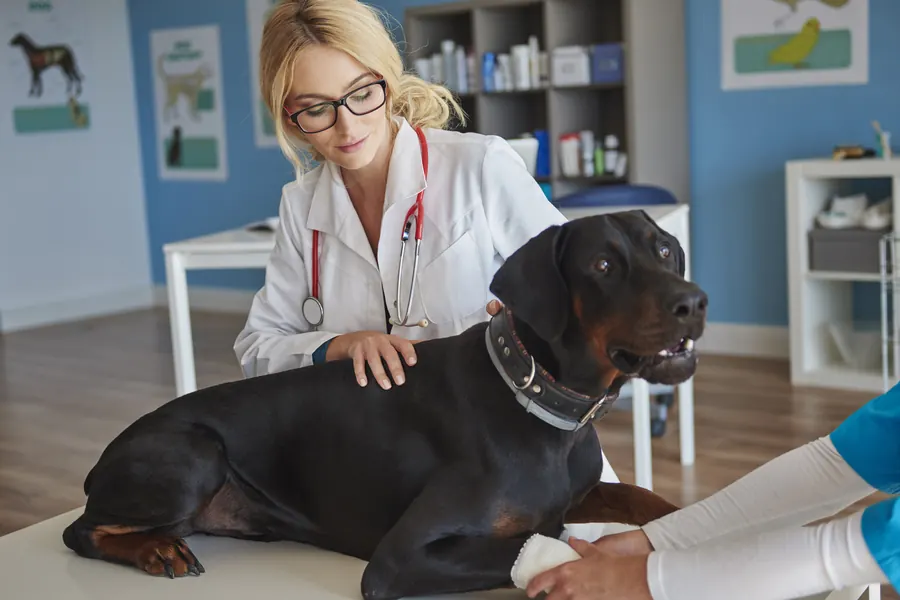
When to see a vet urgently
Go to an emergency vet immediately if you suspect a twisted stomach; do not stay at home waiting for signs to develop.
- Your dog repeatedly tries to vomit, but brings up little or nothing.
- The abdomen swells and your dog is in pain or very restless.
- Your dog is weak, unsteady or collapses.
- The gums look pale, or breathing becomes difficult alongside abdominal signs.
Call the veterinary team as you set off and describe the signs. If necessary, find a vet near you providing emergency care.
Overview
Gastric dilatation means a build-up of gas and fluid in the stomach. With volvulus, the stomach changes position so that its contents cannot leave normally. Together, these are known by the abbreviation GDV. You cannot reliably distinguish simple dilatation from a twist by looking at your dog's abdomen; the distinction requires veterinary examination and X-rays.
The disease is particularly associated with large, deep-chested dogs. However, dogs of other sizes can also be affected. Without medical and surgical treatment, a twisted stomach is fatal, so the urgency of seeking help depends on the signs rather than a list of breeds.
Causes
The disease develops through the combined effects of several factors. The exact sequence of dilatation and twisting is unknown. Gas and fluid become trapped in the stomach because the twist prevents them from leaving normally.
The enlarged stomach presses on major blood vessels and reduces the return of blood to the heart. Tissues then receive too little blood, and blood pressure falls. This failure of the circulation is called shock. Blood supply to the stomach itself may also be compromised. The nearby spleen may become involved in the twist too.
The large stomach can also press on the diaphragm, which is involved in breathing. Breathing difficulty is therefore more than an expression of pain or fear. It can be part of the same serious problem affecting circulation and the abdomen.
As the stomach twists, it may also displace the closely attached spleen. Stretching and damage to the spleen's blood vessels can cause internal bleeding. Blood pooling in abdominal vessels reduces the amount circulating effectively around the body. This threatens the intestinal blood supply and oxygen delivery to tissues.
Risk factors
A deep, narrow chest and a close relative with a history of GDV are established risk factors. Risk also increases with age.
At-risk breeds include Great Danes, German Shepherd Dogs, Irish Setters, Weimaraners, St Bernards and Standard Poodles. No clear difference in susceptibility between the sexes has been established. Eating rapidly, large meals and infrequent feeding have also been associated with the disease.
Stress, fearful or aggressive behaviour and previous removal of the spleen have been associated with GDV. A first-degree relative means a parent, sibling or offspring whose history of GDV increases a dog's risk. A lean build and loosening of the ligaments supporting the stomach are also described risk factors.
Typical symptoms
At first, your dog may seem restless and change position repeatedly. Retching is typically unproductive, so do not judge the situation solely by whether your dog eventually brings up food. The abdomen may enlarge gradually or quickly. As the signs progress, your dog may become weak and stop moving as usual.
- Repeated retching without bringing up a proper vomit.
- More drooling and panting than usual.
- Restless pacing and difficulty settling down to rest.
- An enlarged or clearly tender abdomen.
- Weakness, pale gums or collapse.
A dog in pain may adopt a stretching posture with the front legs outstretched and the chest close to the floor. When breathing becomes difficult, the expanded stomach restricts movement of the diaphragm.
Complications and consequences
Impaired circulation can damage the stomach wall so severely that tissue dies. In the worst cases, the stomach ruptures. The damaged digestive tract can allow bacteria into the bloodstream, leading to sepsis. Abnormal heart rhythms can also occur with oxygen deprivation.
The outlook depends on the severity of the disease and how long treatment is delayed. If parts of the stomach or the spleen need to be removed, the outlook may be more guarded. Restoring the stomach's position does not immediately remove every risk, which is why hospital monitoring continues after surgery.
Even the return of blood flow can damage tissues. This is called reperfusion injury: after the twist is corrected, harmful substances that have accumulated in the tissues are released into the body. It can be associated with abnormal heart rhythms and reduced kidney or liver function.
Estimated mortality is around 15–30%. More than 80% of dogs receiving medical and surgical treatment survive. Signs lasting more than 6 hours before treatment worsen the outlook. The need to remove part of the stomach or the spleen also increases the risk of death.
Less common dangers after surgery include peritonitis and a widespread blood-clotting disorder. Peritonitis and sepsis are also findings associated with a higher risk of death. Prolonged shock can impair organ function even though surgery has corrected the stomach's position.
Diagnosis at the vet
The vet establishes when the signs began and examines your dog's general condition and abdomen. Your dog's size, history and combination of signs may raise strong suspicion on arrival. Investigations aim to identify a twist while assessing how far the circulation has already been affected.
Abdominal X-rays help distinguish a twist from simple dilatation. An ECG, or electrocardiogram, shows abnormal heart rhythms that can develop during the disease. Blood tests examine blood cells, electrolyte balance and disturbances in the body's metabolism, among other things. These tests do more than name the diagnosis: their results also guide safe treatment.
Blood lactate partly reflects the effects of impaired circulation and the inflammatory response. Blood pressure and the heart's electrical activity may be monitored continuously, as the condition can change during treatment.
Successfully passing a tube into the stomach to decompress it does not, on its own, rule out a twist.
On an X-ray, the gas-filled stomach may appear divided into separate compartments because its wall has folded. Gas visible within the stomach wall suggests tissue damage. Free gas in the abdominal cavity may indicate a ruptured stomach.
A blood lactate level above 6 mmol/l is associated with a greater likelihood of stomach tissue death and partial removal of the stomach. A blood count, kidney values, blood glucose and electrolyte levels help assess the whole body's condition. Clotting tests are also part of assessing a severely ill patient.
Before planned preventive stomach fixation, tests are chosen according to your dog's age and general health. A blood count and biochemical tests can assess liver and kidney function before anaesthesia. Urine testing or chest X-rays may also be recommended for an older dog.
Treatment
The vet begins stabilising the circulation and providing pain relief. Intravenous fluid therapy is central to treating shock. Some patients also need oxygen or a blood transfusion. Investigations, stabilisation and preparation for surgery may need to be coordinated rapidly; the timing of surgery depends on the patient's condition.
The vet relieves pressure in the stomach by removing gas and contents. This may involve a stomach tube or an instrument passed through the abdominal wall. These procedures belong in a veterinary setting. Do not try to puncture your dog's abdomen or pass a tube yourself; take your dog for professional treatment without delay.
Antibiotics may be used because bacteria can pass from the damaged intestine into the body.
During surgery, the stomach is returned to its normal position and the tissues are checked for viability. Dead stomach tissue or a damaged spleen may need to be removed. Fixing the stomach in place, called gastropexy, reduces the risk of another twist. This involves attaching the stomach to the abdominal wall; removing gas alone does not replace this correction.
Monitoring and supportive care continue in hospital after surgery. At home, exercise is restricted to allow the wound to heal, and food is offered in smaller portions according to the treatment instructions.
Not every abnormal heart rhythm detected after surgery needs a specific medicine to control it. Some are temporary, but their significance is assessed through monitoring.
After preventive gastropexy, quiet rest at home and restricted exercise are recommended for 10–14 days. The wound is protected from licking to prevent infection or reopening. This recovery advice for a planned procedure does not describe how long a patient in shock needs intensive care.
Supportive care after surgery includes intravenous fluids and pain relief. The veterinary team decides when feeding begins; a period without food of 12–48 hours after the procedure is described. An anti-sickness medicine may be given for persistent vomiting. Monitoring of blood pressure, blood glucose, electrolytes and lactate continues after the procedure.
Prevention
Preventive gastropexy may be considered for a dog at high risk. It can be performed alongside another planned operation or as a separate procedure. The discussion takes account of your dog's build, family history and health. Fixing the stomach reduces the risk of twisting, but the stomach can still dilate. Having had the procedure is therefore no reason to ignore retching or abdominal swelling later on.
Preventive gastropexy can be performed through open surgery or with laparoscopic assistance. The choice of technique depends on the expertise available and your dog's circumstances.
Divide the day's food into 2–3 smaller meals rather than one large meal. A food calculator can help you work out portion sizes. Restrict exertion after meals. Avoid a raised food bowl.
A recurrence risk of 3–5% has been described after gastropexy, compared with up to 80% without fixation. Fixation prevents twisting, but does not prevent the stomach from dilating again.
Important for dog owners
Save the address of an emergency veterinary service and plan in advance how to get a large dog into the car if needed. Keep a record of the names and dates of previous abdominal operations. In an emergency, mention unproductive retching, swelling and changes in your dog's condition first. Note when signs were first noticed and when your dog was last their normal self.
During recovery, prepare a list of questions for the vet treating your dog: what your dog can eat, how to manage walks, who will check the wound and when exercise can increase. Ask for written instructions and share them with everyone caring for your dog. Record meals actually eaten and changes in condition, so follow-up discussions can draw on more than a general impression of a better or worse day.
Frequently asked questions
Can a twisted stomach resolve on its own?
A suspected twisted stomach must be treated as an emergency. Treatment requires prompt veterinary assessment and surgical correction; there is no safe general advice to wait at home. Go to an emergency vet based on the signs and call ahead so the team can prepare.
Can a small dog get a twisted stomach?
Yes, although the disease is much more common in large, deep-chested dogs. Size alone does not rule it out. If a small dog retches unproductively, develops a swollen abdomen or becomes less well, those signs need veterinary assessment just as they would in a larger dog.
Does gastropexy also prevent bloating?
Gastropexy aims to prevent the stomach from twisting, but does not prevent all dilatation. Swelling and abdominal signs must still be taken seriously after the procedure. Tell the emergency vet that gastropexy has been performed and bring any previous operation report.
Why is a dog still monitored after surgery?
The effects of the disease do not end when the stomach is back in position. After surgery, the team monitors for problems such as abnormal heart rhythms and severe inflammation, and provides supportive care. Discharge depends on recovery, so hospital stays can differ between dogs treated for the same diagnosis.
Is a raised food bowl a good way to prevent GDV?
A raised food bowl is not recommended as a way to prevent GDV. Discuss the overall feeding routine with your vet: meal size, rapid eating and individual risk all inform the discussion. A choice of bowl does not replace considering preventive gastropexy for a high-risk dog or seeking emergency care when signs develop.
Sources
- Gastric Dilatation-Volvulus, American College of Veterinary Surgeons, accessed 2026-11-02.
- Gastric dilatation volvulus (GDV) or bloat, Cornell University College of Veterinary Medicine, accessed 2026-11-02.
- Gastric Dilation and Volvulus in Small Animals, MSD Veterinary Manual, accessed 2026-11-02.
- Prophylactic Gastropexy, American College of Veterinary Surgeons, accessed 2026-11-02.
- Mahalaukunkiertymä, Kiharakerho ry, accessed 2026-11-03.
This information does not replace a visit to a vet. In an emergency, contact your nearest emergency vet: find a vet (RCVS).
More on this topic: Digestive system
- Echinococcus tapeworms in dogs – infection and echinococcosis
- Giardia in dogs: symptoms, tests and treatment
- EPI in dogs: pancreatic insufficiency symptoms and treatment
- Pancreatitis in dogs: symptoms, tests and treatment
- Mould poisoning in dogs: mouldy food and compost
- Flatulence in dogs: causes, diet and investigations