When to see a vet urgently
Contact a vet immediately if your cat has any of the following:
- repeated vomiting or unproductive retching and is clearly unwell;
- inability to keep food or water down, abdominal pain or unusual tiredness;
- difficulty breathing, or an episode that looks like coughing rather than ordinary vomiting.
Overview
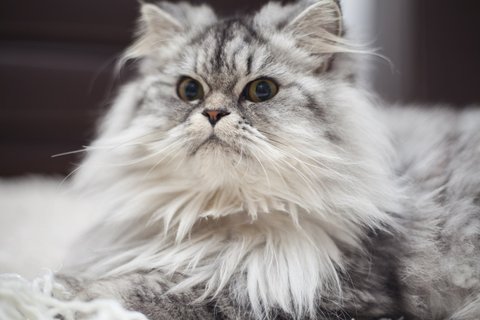
When a cat grooms, hair enters the stomach, where it cannot be digested. Normally it passes through the intestine, but compact masses form when there is too much hair or gastrointestinal movement is disturbed. Long-haired breeds, such as Persians and Maine Coons, are at particularly high risk. Mild cases cause only discomfort, but large accumulations can block the intestine.
Despite the name, a vomited hairball is often a long, damp cylinder of hair. It takes this shape as the mass passes through the narrow oesophagus. Mucus and stomach fluid may also be present. However, not all swallowed hair forms a ball, and a healthy cat does not need to vomit hair regularly to stay well.
Hair is mainly made of keratin, which digestion cannot break down. Assessment distinguishes two possibilities: the cat is swallowing more hair than usual, or its passage through the digestive tract has changed. Both factors may be present in the same cat.
Causes
- normal grooming, particularly during moulting;
- a long or dense coat;
- insufficient help with coat care from the owner;
- itchy skin diseases causing increased licking;
- disturbances of gastrointestinal movement;
- an unsuitable diet containing too little fibre.
A hairball alone does not show inadequate care or an unsuitable diet. Fibre content is only one feature of a diet, and the same amount or type does not suit every cat. Pain and stress, as well as itching, can maintain excessive licking. More brushing alone does not resolve these underlying causes.
Risk factors
- long-haired breeds, such as Persians, Maine Coons and Siberians;
- cats during moulting;
- cats with skin problems or behavioural disorders involving compulsive licking;
- older cats with reduced intestinal movement.
A long coat and moulting help assess how much hair is swallowed, but short-haired cats can also be affected. Age or breed does not adequately explain new vomiting. Where necessary, a cat repeatedly vomiting hair is investigated for skin disease or a gastrointestinal disorder, rather than the symptom automatically being accepted as a normal breed characteristic.
Typical symptoms
- intermittent vomiting of hair masses;
- constipation or irregular bowel movements;
- loss of appetite and weight loss;
- tiredness and reduced activity;
- discomfort or abdominal pain;
- with an obstruction, sudden vomiting, no longer passing stools and severe illness.
Finding hair in vomit does not establish that it is the only cause of vomiting. Conversely, a hair mass causing an obstruction may remain inside, so no hair is visible in the vomit. Changes in appetite, bowel movements and general health are therefore important observations.
Vomiting is often preceded by lip-licking, swallowing and drooling, followed by abdominal muscle contractions. Coughing can look like similar retching. Repeated episodes that produce no hair may be associated with asthma, for example. If you can record an episode without disturbing your cat or delaying care, a video helps the vet understand what happens at home.
Complications and consequences
- chronic stomach inflammation;
- constipation and inflammation of the colon;
- intestinal obstruction requiring surgery;
- secondary inflammation of the digestive tract.
An intestinal obstruction caused by a hairball is uncommon but serious. Fluid and gas accumulate above the blockage, and vomiting can cause dehydration and electrolyte imbalances. A prolonged obstruction can damage the intestinal wall and lead to perforation and peritonitis. These are different from a single episode of vomiting a hairball.
An obstruction may be partial or complete. The severity of symptoms and amount of vomiting vary with its location. Passing stools or the absence of vomiting therefore does not rule out obstruction if the cat is otherwise unwell.
Diagnosis at the vet
- the history, including frequent vomiting of hair;
- examination of the abdomen by touch, as a mass can sometimes be felt;
- gastrointestinal X-rays or ultrasound to look for a bezoar;
- endoscopy, which may identify and remove a bezoar during the same procedure.
Tell the practice how often your cat vomits, what is visible in the vomit and whether the symptom has changed. Mention weight loss, appetite changes, stool quality, itchy skin and increased licking too. As well as the abdomen, the vet examines the skin and coat and assesses general condition and fluid balance.
Blood tests investigate the consequences of vomiting and the possibility of other diseases, among other things. X-rays may look for enlarged intestinal loops or other signs of obstruction; the hair mass itself is not always clearly visible. Ultrasound or other additional imaging helps as appropriate. Endoscopy mainly reaches the stomach and the beginning of the digestive tract, so it cannot investigate or remove every intestinal obstruction.
If hairballs keep occurring, investigations may also focus on underlying intestinal or skin disease. Identifying a hairball on the floor alone does not explain why they form repeatedly.
Persistent symptoms may warrant urine and faecal testing and assessment of thyroid function, for example. Intestinal disease does not always cause diarrhoea, and disease changes may exist even when ultrasound looks normal. If suspicion persists, the vet may recommend tissue samples. These investigations are not needed after every isolated hairball; the need depends on the overall symptoms and previous findings.
Treatment and recovery
Treatment depends on whether there is occasional hair accumulation or a confirmed obstruction. If an obstruction is suspected, do not try laxatives, oils or new fibre supplements at home before veterinary assessment. Do not try to induce vomiting either. Something other than a hairball may be responsible, and an obstructed intestine may need a procedure.
In hospital, fluid and electrolyte deficits are corrected before anaesthesia where necessary. A hair mass in the stomach can sometimes be removed by endoscopy. An intestinal obstruction often requires surgery, during which the bowel's condition and any other obstruction sites are also checked. A severely damaged section may need to be removed.
The outlook is generally better when the obstruction is found before significant bowel damage. After surgery, feeding, medicines and activity follow the discharge instructions. Report new vomiting, failure to eat, abdominal pain or deterioration to the vet treating your cat; removing a hairball does not prevent other complications afterwards.
Prevention
- Brush your cat regularly, especially if long-haired.
- Use special foods and treats that help hairballs pass.
- Use malt or liquid paraffin pastes or fibre supplements as instructed by the vet.
- Treat skin and behavioural problems that cause excessive licking.
- Keep your cat active to support normal intestinal movement.
Special foods and products aim to help hair pass in the faeces, rather than make persistent vomiting acceptable. Effects differ between products and cats. In a small feeding trial investigating fibre, faecal output changed, but the total number of faecal hairballs did not decrease significantly. This does not show that every fibre diet is ineffective, but adding fibre alone cannot guarantee resolution.
Do not force liquid paraffin into a cat's mouth with a syringe. Oil entering the airways can cause serious pneumonia, and cats are particularly susceptible. The vet assesses whether a product is needed and how its use fits your cat's situation.
Brushing reduces loose hair, but also watch for increased licking or bald areas. Record whether hairballs become less frequent with agreed changes and whether appetite and normal bowel movements are maintained. If symptoms persist, prevention is supplemented by investigating the cause, rather than adding several products on your own.
If food is changed, do so gradually in the way agreed with the vet. An abrupt change can itself cause digestive upset. Mention current treats and supplements too, so the whole diet can be assessed and conflicting dietary changes are not tried to manage hairballs.
Important for cat owners
Hairballs are a common problem in cats, but appropriate grooming and feeding can prevent them. Remember that frequent vomiting of hair, particularly with constipation or refusing food, warrants a veterinary visit. This helps avoid serious complications such as intestinal obstruction.
This article provides general information and does not replace veterinary care. If you notice signs of illness in your cat, contact a vet.
Frequently asked questions
Are hairballs always normal?
A single hairball in a cat that is otherwise well does not necessarily mean serious disease. However, repeated vomiting, weight loss or appetite changes need investigation, even if the vomit always contains hair.
Can there be an obstruction without hair in the vomit?
Yes. The hair mass causing the blockage may remain in the digestive tract. Repeated vomiting, abdominal pain and inability to keep water down need urgent assessment, rather than waiting for a hairball to appear.
Will hairball food help if my cat coughs?
Not necessarily, as coughing can indicate a respiratory disease. The cause of the episode needs to be identified first. Breathing difficulty requires urgent care rather than a trial of different food.
How often is it acceptable for a cat to bring up hairballs?
There is no safe number that applies to every cat. An increase in episodes, other vomiting and changes in weight or appetite determine the need for investigation. Record events so that you do not have to rely on memory for their frequency.
This article is for general information only and is not a guide to treatment. If you notice the first signs of illness, contact your vet.
Paw4care editorial team
Sources
- The Danger of Hairballs, Cornell University College of Veterinary Medicine, accessed 2026-11-03.
- Trichobezoars (Hairballs) in Cats, VCA Animal Hospitals, accessed 2026-11-03.
- Managing Hairballs in Cats, Merck Veterinary Manual, accessed 2026-11-03.
- Gastrointestinal Obstruction in Small Animals, Merck Veterinary Manual, accessed 2026-11-03.
- Effects of psyllium husk utilisation on the efficiency of feed utilisation and the faecal hairballs elimination, Food Agricultural Sciences and Technology, accessed 2026-11-03.
- Vomiting in Cats, Cats Protection, accessed 2026-11-03.
- Pneumonia in Cats, Merck Veterinary Manual, accessed 2026-11-03.
- ACVIM consensus statement guidelines on diagnosing and distinguishing low-grade neoplastic from inflammatory lymphocytic chronic enteropathies in cats, ACVIM, Journal of Veterinary Internal Medicine, accessed 2026-11-03.