
Dog diseases · Eyes, ears and mouth
Blepharitis in dogs
Blepharitis is inflammation affecting eyelid skin, margins or glands. The eyelid can become red, swollen and itchy. Severe squinting or surface cloudiness requires prompt examination.
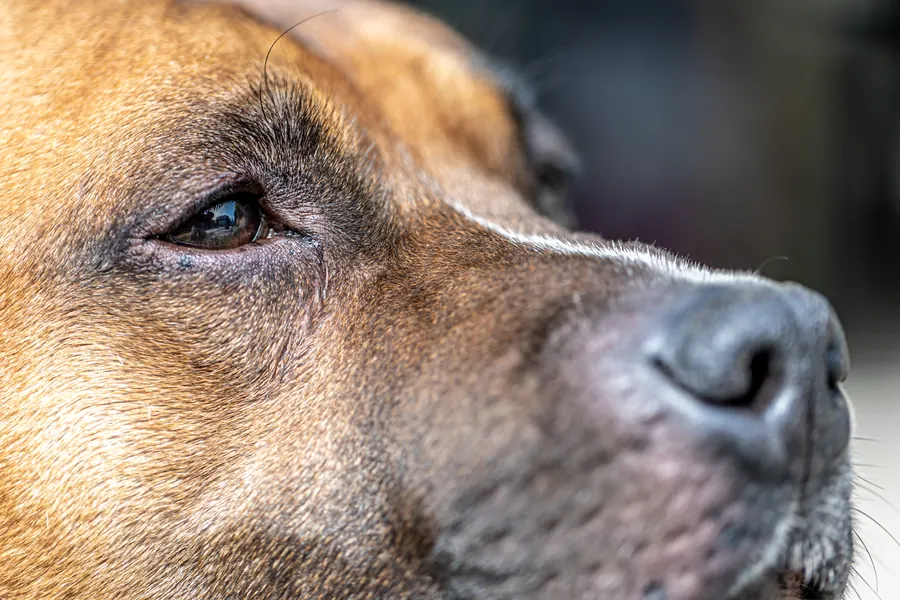
When to see a vet urgently
Contact a vet within days for persistent or recurring redness, crusting or itching. Call an emergency clinic immediately for these signs.
- Keeping an eye closed through pain or severe squinting.
- Sudden cloudiness of the clear surface.
- Apparently abnormal vision developing suddenly.
- A clear change in shape or bulging.
- Accidental eye or eyelid injury.
Overview
Eyelids protect the surface
Closing lids protect the cornea from drying and injury. The inner surface is lined by conjunctiva, a thin membrane. A thin lipid layer covers the more watery tear layer beneath. Meibomian glands along the margins secrete oily material into the film. This slows evaporation. Bacterial inflammation can affect one gland or extend across the lid.
Surrounding skin can also become inflamed. A German 102-dog population had concurrent periocular inflammation in 69%. Dogs were selected for blepharitis with confirmed skin disease. Only 2.9% had blepharitis without other skin changes. Twenty-two had lid inflammation without periocular involvement but lesions elsewhere. Six could not be distinguished as lid-only versus periocular cases.
Causes
Skin disease, infection and parasites
Periocular itching and redness can accompany atopic dermatitis. Food allergy or insect sting reactions can also affect lids. Allergic skin disease underlay 52% of German cases. Infection or parasites accounted for 21.5%. Autoimmune disease accounted for 17.7%. Tumours accounted for 4.9%.
Demodex mites can multiply in follicles, producing red, hairless patches. Parasite-related blepharitis can involve surrounding skin. Bacteria can infect a gland and cause a local stye. Ruptured Meibomian glands can release oily secretions into tissue. Inflammation around leaked material can form a firm lump called a chalazion.
Lid changes and puppy facial disease
Inward-rolling lids can rub the surface and predispose to blepharitis. Gland tumours can irritate the surface. Juvenile sterile granulomatous dermatitis can swell the face and ear flaps. Some cases remain unexplained despite investigations.
Glaucoma drops were suspected in periocular dermatitis in two atopic Shih Tzus. Signs began 94 and 104 days after starting eye medication.
Risk factors
Brachycephalic dogs were proportionately overrepresented in the German group. Large eyelid openings can prevent complete closure and predispose to surface injury. Prominent nasal fold hairs can contact the cornea in very short-muzzled dogs. Medial lower lid inversion can also alter tear duct opening position. Tears may then overflow onto the cheek instead of draining normally. Extra lashes can rub if directed towards the eye.
Atopic periocular signs can occur alongside ear or paw inflammation. Most atopic dogs first show signs between six months and three years. Juvenile sterile granulomatous dermatitis typically occurs between three weeks and four months.
Typical symptoms
One or both eyes can be affected. Inflamed lids can itch. Surface irritation can cause rapid blinking or squinting.
- Red eyelid skin.
- Thickening through swelling.
- Hair loss on or around lids.
- Crusted margins.
- Rubbing with a paw or against surfaces.
- Watery or purulent discharge.
Hair loss or thinning affected 97% of the 102 German patients. Redness occurred in 93%. Swelling occurred in 50%. Crusts occurred in 39.2%.
Persistent inflammation can reduce skin pigment. Small bumps or pustules can form. Local swelling can affect one or several margin glands. Puppies with sudden sterile granulomatous facial inflammation can also have enlarged mandibular nodes. Ear flap skin may weep concurrently.
Complications and consequences
Tear film and cornea
Gland dysfunction can weaken the lipid layer. Tears can evaporate faster. The German study found reduced production in 10 of 53 measured dogs. Another study included 81 dogs with ocular surface disease. Gland dysfunction affected 105 of 150 eyes, or 70%. Tear test results were not statistically associated with dysfunction.
Rubbing can injure the cornea. Scratching an inflamed lid can damage surrounding skin too. Severe inflammation can extend to conjunctiva. It can also reach the cornea. Chronic dryness can cloud the cornea and impair vision. Inward lid rubbing can cause painful ulceration.
Diagnosis at the vet
Eye and skin examination
The vet assesses lids and surfaces of both eyes. Margins are checked for rubbing lashes. Wider skin signs prompt examination elsewhere for underlying disease. Suspected bacteria can be sampled from beneath a crust, for example.
Schirmer testing measures tear production. It has been recommended for every dog with blepharitis. Fluorescein identifies superficial corneal injury. Infrared imaging can investigate suspected gland dysfunction.
One report described a two-year-old crossbreed with blepharitis and sebaceous adenitis. Its Meibomian glands appeared shorter and thinner on imaging.
Samples distinguish causes
Cytology examines a sample for inflammatory cells and bacteria. Skin scrapings can be examined for Demodex mites. Plucked hairs can be examined when scraping near the eye is difficult. Culture and susceptibility guide bacterial treatment. Suspicious eyelid lumps can be biopsied. Histology can also identify sterile inflammation resembling a tumour. Unexplained local disease may warrant blood tests for underlying conditions.
Treatment
Protecting the lid and treating the cause
The vet chooses treatment according to the cause of blepharitis. A vet-recommended warm compress can provide temporary relief. Sterile eye wash can remove discharge before prescribed topical treatment. A collar can protect the surface against repeated scratching.
Confirmed local bacterial infection may need a prescribed ocular antibiotic ointment or drops. Deep bacterial skin infection treatment can follow culture and susceptibility results. Demodex inflammation needs effective antiparasitic medication. Surgery can correct abnormal lid position rubbing the cornea. An irritating tumour can be removed surgically. Prognosis is good for congenital lid malposition-associated inflammation if correction succeeds. Some unexplained cases can be controlled with topical eye medication.
Allergic and sterile inflammation
Allergy treatment and avoiding triggers can help allergic blepharitis. Juvenile sterile granulomatous dermatitis needs immunosuppressive treatment. Concurrent bacterial skin infection can require sample-guided treatment. Corticosteroid eye medicines are unsuitable with corneal ulcers.
A four-dog series of rare sterile periocular granulomatous inflammation found resolution in all after immunosuppression. None recurred during average follow-up of 17.3 months.
The crossbreed with sebaceous adenitis improved over three weeks. Gland ducts remained obstructed on imaging.
Prevention
Managing underlying allergy reduces associated symptoms. Tobacco smoke can irritate lids. Long hair contacting the surface can be trimmed to stop rubbing. Gentle handling around the eyes from puppyhood can ease later prescribed drop application. Check periocular skin more closely during seasonal atopic flare-ups. Report persistent tearing even without crusts.
Important for dog owners
Record whether one or both eyes and other skin areas are affected. Report current eye medicines before new treatment. Do not use human or another pet's medicines without veterinary advice. Keep the dropper tip away from the eye and lid. Wash hands before and afterwards to prevent contamination and spread. Contact the treating vet for increased redness or inflammation after application.
Frequently asked questions
Is blepharitis the same as conjunctivitis?
Blepharitis affects lids with redness, swelling or crusts, for example. Conjunctivitis affects the membrane covering the surface and inner lids. The same dog can have inflammation of both the eyelid and the conjunctiva. With blepharitis, skin changes may also be visible elsewhere on the body.
What if there is a lump on the lid?
A local lump can be an inflamed eyelid gland or a tumour, for example. The vet examines where the lump lies and whether it touches the surface of the eye. If a tumour is suspected, a tissue sample can help establish the nature of the lump. A lump can also form through an inflammatory reaction to secretions leaking from a gland into eyelid tissue.
Are antibiotics always needed?
The choice of treatment depends on what is causing the inflammation. An antiparasitic medicine is used to treat Demodex mites. Examination of a cell sample can identify inflammation caused by bacteria. When necessary, culture results help the vet select an antibiotic effective against the bacteria. Treatment of sterile granulomatous inflammation may instead be based on suppressing the immune response.
Can I clean eyelids at home?
Discharge around the eye can be removed with a sterile wash intended for use around eyes. If the eye is painful or cloudy, your dog needs a prompt veterinary examination. Keep the wash bottle tip away from the eye and other surfaces. Wash hands before handling periocular skin or applying drops.
Why can blepharitis recur?
If atopy underlies the inflammation, your dog may develop eyelid signs during flare-ups of the skin disease. Abnormal lid position can maintain irritation if the lid continues to rub the eye. Repeated bacterial infections prompt investigation of the underlying cause that predisposes the dog to inflammation. At the same appointment, the vet can measure tear production and examine the surface of the eye.
Sources
- Blepharitis in dogs: a clinical evaluation in 102 dogs, Veterinary Dermatology / Crossref, accessed 2026-11-07.
- Disorders of the Eyelids in Dogs, Merck Veterinary Manual, accessed 2026-11-07.
- Blepharitis in Dogs, VCA Animal Hospitals, accessed 2026-11-07.
- Silmäsairaudet, Helsingin yliopisto, accessed 2026-11-07.
- Silmäsairaudet ja -tutkimukset, Suomen Kennelliitto, accessed 2026-11-07.
- Muut koiran sairaudet: koiran atopia, Suomen Kennelliitto, accessed 2026-11-07.
- Koiran perushoito, Suomen Kennelliitto, accessed 2026-11-07.
- Meibomian gland dysfunction in dogs with ocular surface disorders, BMC Veterinary Research, accessed 2026-11-07.
- A comparative review of evaporative dry eye disease and meibomian gland dysfunction in dogs and humans, Veterinary Ophthalmology, accessed 2026-11-07.
- Synopsis of the antimicrobial use guidelines for canine pyoderma, Veterinary Dermatology / ISCAID, accessed 2026-11-07.
- Koiran syvä ihotulehdus, Ruokavirasto, accessed 2026-11-07.
- Juvenile cellulitis in a 9-week-old puppy, Canadian Veterinary Journal, accessed 2026-11-07.
- Idiopathic Granulomatous Inflammation of the Periocular Structures in Four Dogs, Veterinary Medicine and Science, accessed 2026-11-07.
- Ocular Neoplasia in Dogs, Merck Veterinary Manual, accessed 2026-11-07.
- Demodex spp. for Dog, Companion Animal Parasite Council, accessed 2026-11-07.
- Potentially Dangerous Items for Your Pet, U.S. Food and Drug Administration, accessed 2026-11-07.
- Anti-inflammatory Agents in Animals, Merck Veterinary Manual, accessed 2026-11-07.
- Applying Eye Drops to Dogs, VCA Animal Hospitals, accessed 2026-11-07.
- Sterile Eye Wash, VCA Animal Hospitals, accessed 2026-11-07.
- Koiran silmätulehdus, Vetsy, accessed 2026-11-07.
- A Case of Sebaceous Adenitis and Concurrent Meibomian Gland Dysfunction in a Dog, Frontiers in Veterinary Science, accessed 2026-11-07.
- Diagnostic approach and grading scheme for canine allergic conjunctivitis, BMC Veterinary Research, accessed 2026-11-07.
- Delayed periocular dermatitis as a side-effect of topical anti-glaucoma eyedrops in two dogs, Journal of Veterinary Science, accessed 2026-11-07.
This information does not replace a visit to a vet. In an emergency, contact your nearest emergency vet: find a vet (RCVS).