
Dog diseases · Eyes, ears and mouth
Broken teeth in dogs: symptoms and treatment options
A tooth fracture means a dog's tooth has chipped or broken. It can expose the pulp inside, which contains nerves and blood vessels. Exposed pulp needs treatment even if the tooth is no longer bleeding. Depending on the situation, options include sealing, pulp therapy, root canal treatment or extraction.
When to see a vet urgently
Have a new dental injury examined promptly by a vet. Treatment that keeps the pulp alive has the best chance of success when performed preferably within 24–48 hours of the accident.
- A red spot or black hole is visible in the centre of the broken tooth.
- The face swells or a pus-draining opening develops on the skin near a tooth.
- Your dog cannot eat after a mouth injury.
- The mouth hangs open after an accident.
- The bite changes suddenly after an injury to the jaw.
You can find a vet near you for help.
Overview
Tooth fractures are common in dogs. The outermost layer is enamel, with dentine underneath. Exposed dentine can cause sensitivity to cold and heat. The pulp in the centre also supports dentine formation.
In a complicated fracture, the pulp is exposed. In an uncomplicated fracture, damage does not extend into the pulp. A small chip confined to enamel can sometimes be monitored. Leaving a fracture that reaches the pulp untreated leads to the tooth dying. Fractures are therefore assessed by depth, rather than simply by the size of the missing piece.
The crown is the part of a tooth visible above the gum. A visible surface fracture does not reveal everything about the root, so dental X-rays form part of the investigation. Pulp inflammation can develop even when enamel damage has not yet left a visible opening into it.
Causes
A common cause is chewing something too hard for a dog's teeth. Bones, antlers, hooves and stones can cause damage, for example. Biting a hard nylon toy can also fracture a tooth. Gripping a fence or cage bars with the teeth can cause a fracture too. Chewing ice cubes is another habit to avoid.
A tooth can also break in a road accident or a fall onto a hard surface. Fighting with another animal can damage both teeth and jaws. A forceful blow can injure the pulp even without a visible crown fracture. Enamel damage opens a route for bacteria towards pulp tissue.
The pulp's blood supply enters through the root tip. It has no alternative collateral blood supply, reducing its ability to survive severe injury. Pulp inflamed by a minor injury may still recover. Bleeding within the pulp can discolour a tooth as blood enters tiny tubules in the dentine.
Risk factors
Dogs of any size or breed can fracture their teeth. Hard chewing and rough play increase exposure to forces that damage teeth. Canines and the large carnassial teeth at the back of the mouth are common fracture sites. The large upper carnassial is the fourth premolar.
Baby canines are long, delicate and prone to breaking when puppies chew. A recently erupted permanent tooth still has an immature root that is vulnerable to damage. Root development continues for several months after eruption. The tooth's developmental stage therefore also influences treatment choices in a growing dog.
A young dog's relatively large pulp cavity also affects the treatment needed for exposed dentine.
Typical symptoms
A tooth fracture may be found by chance during a mouth check without any remembered accident. Dogs do not always show obvious pain even with serious oral disease. Changes you may notice at home include:
- A piece missing from the tip of a canine.
- An uneven tooth surface or unusual tartar accumulation on it.
- Avoiding hard treats and chew toys.
- Going to the food bowl but leaving without eating.
- Discomfort when drinking cold water.
- A tooth turning pink, purple or grey.
- Increased drooling.
Pulp bleeding can stop soon after an accident even though the pulp remains open to the mouth. An old fracture may show black, brown or pus-like discharge. A tooth root infection can also appear as a small draining bump on the gum beside the tooth.
An abscess at an upper canine root can cause swelling beside the nose.
Complications and consequences
Pulpitis means inflammation of the dental pulp. Severe injury can lead to irreversible pulpitis and pulp death. Infection can extend into tissues around the root tip and form an abscess. Infection of an upper carnassial tooth can appear as swelling or pus discharge below the inner corner of the eye.
After the pulp dies, a tooth may cause few signs for months or years before infection causes renewed pain. Improvement in signs therefore does not prove the tooth has healed. Of teeth discoloured internally, 87–92% have been found to be non-vital. Pulp infection in a baby tooth can damage the permanent tooth germ developing beneath it.
Among root canal treatments of 120 fractured upper fourth premolars, 90.83% were classified as successful. In 8.33% of treated teeth, no failure was detected, but healing remained uncertain. A further 0.83% of treatments were classified as failures. The results apply to dogs weighing less than 25 kg. Follow-up averaged 11.65 months. Teeth with severe periodontal disease were excluded.
Diagnosis at the vet
The vet assesses the visible fracture and any possible pulp exposure. Dental X-rays establish the extent of the fracture into the root. However, an X-ray alone does not reliably show whether the pulp is directly open to the mouth. Under general anaesthesia or deep sedation, the fracture surface can be examined with a probe, a small instrument used to feel the area. Tartar may cover exposed pulp that becomes apparent during cleaning.
X-rays also assess the root tip and surrounding bone. An unusually wide pulp cavity can indicate that tooth development stopped after pulp death. A recent root-tip abscess may not yet produce an obvious X-ray change. After an accident, a tooth thought to be missing may still have a root beneath the gum.
The vet compares pulp cavity width with healthy neighbouring teeth or those on the opposite side. After a major jaw injury, CT may be needed to establish the extent of damage. Other serious injuries, such as jaw fractures, are treated before an individual tooth is repaired.
Before general anaesthesia, the vet takes a medical history and performs a general examination. Blood samples for laboratory tests may help plan the anaesthetic. Heart disease or another underlying illness may require further investigation. The aim is an anaesthetic plan suited to your dog's health.
Treatment
The vet prescribes treatment and pain relief. Fracture depth, your dog's age and time since the accident affect the choice. A loose fractured tooth cannot simply be left for monitoring. With a superficial fracture, sharp edges can be smoothed or the tooth repaired with a filling. Sealing exposed dentine can reduce sensitivity.
For a recent fracture reaching the pulp, partial pulpotomy, meaning removal of the damaged portion of pulp, may be considered. The remaining living tissue is protected and the tooth sealed with filling material. The aim is to preserve the tooth's ability to form more dentine. In a developing tooth, treatment may also allow the root tip to close.
Root canal treatment removes all pulp tissue, then cleans and fills the canals. The tooth is finally sealed against bacteria from the mouth. Root canal treatment is considered particularly to save functionally important canine and carnassial teeth. A root-treated tooth no longer strengthens by producing more dentine.
Extraction is another option for a fracture reaching the pulp. Removal may require opening the gum and removing a little surrounding bone. The wound is closed with dissolvable sutures. Dogs generally eat better once a painful tooth has been removed. After pulp or root canal treatment, follow-up dental X-rays under general anaesthesia are recommended after 4–6 months and annually thereafter.
Success of pulp-preserving treatment is monitored by checking whether dentine continues to thicken and the tooth develops normally. Bone loss should not develop around the root tip. Root canal follow-up instead checks healing of previous changes around the root and the absence of new ones. A filling can come out or root canal treatment can fail, so monitoring is part of tooth-preserving care.
After extraction, provide soft food for about 2 weeks. Keep chew toys and hard chews away while the wound heals. Have the extraction site checked before returning to normal food and toys.
When preserving a multi-rooted tooth, every root canal must be cleaned and sealed. If this cannot be achieved, that root may need removal. A working dog may sometimes also receive a protective crown to support the remaining tooth structure.
Local anaesthesia may also be given to the area of a painful procedure.
Prevention
A chew toy's material should yield enough for a fingernail to leave an indentation. Soft rubber and soft toys are safer for teeth than hard plastic, bones or antlers. Chew size should also suit your dog: a large chew may be too hard for a small dog.
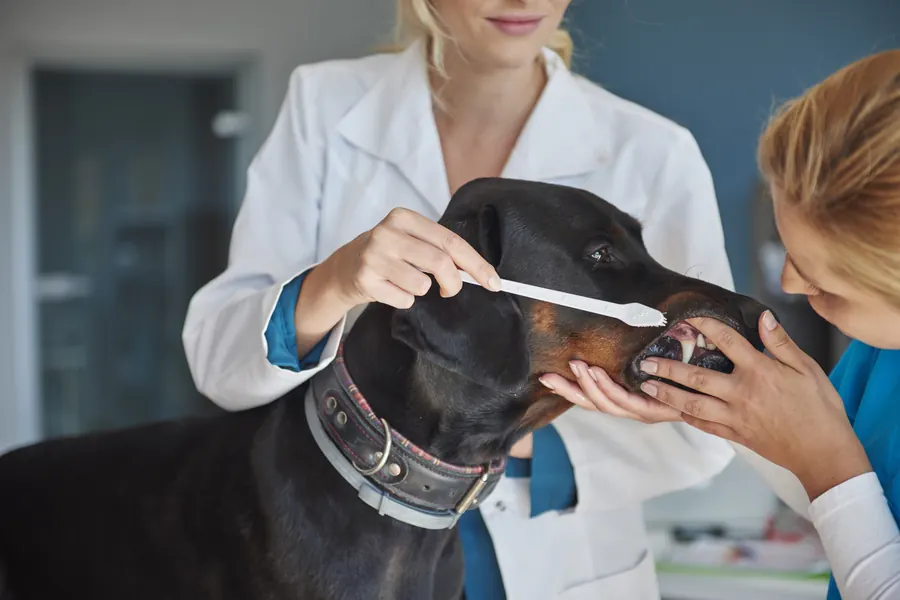
Regular tooth brushing can help you find a chip early. A new colour change in an apparently intact tooth also needs investigation. Toy choices cannot prevent every accident.
Early treatment of dental injury can make care easier. When checking appearance, look at side surfaces as well as the tip, because a fracture may be hidden by tartar.
Important for dog owners
Note when you noticed the damage and what your dog had been chewing beforehand. Tell the vet whether the tooth has changed colour, bled or seemed to affect eating. Bring previous dental treatment records. Do not try to dig into or probe a hole visible in the tooth's centre at home.
For dogs attending some shows or trials, an accidental dental change may require a veterinary certificate accepted under the event's rules. In such systems, the judge decides at their discretion how to take the certificate into account during assessment. Keep dental charts, images and the treatment report.
Some shows require the certificate to be presented to the ring steward before the dog is judged.
Frequently asked questions
Can a broken tooth hurt even if my dog eats?
Yes. Dogs do not always show clear discomfort even with very painful oral disease. Exposed living pulp is painful. A visible dental injury therefore needs veterinary examination even if your dog visits the bowl and manages to eat the day's food.
Is a black spot inside a tooth just dirt?
A black hole on a fracture surface may be the opening into dead pulp. Do not try to clean or dig into this dark area in the tooth's centre with a sharp object at home. The vet examines the fracture and takes X-rays to assess the root too.
Does a broken baby tooth need treatment if it will be replaced anyway?
Yes. Exposed pulp in a fractured baby tooth can damage the nearby permanent tooth germ. Removal of such a baby tooth is recommended as soon as possible. Do not wait for natural replacement by a permanent tooth if the baby tooth is painful or infected.
Can a tooth heal without root canal treatment?
Only some injuries are suitable for monitoring after the vet has examined the tooth and its root. A chip confined to enamel can sometimes be observed. A tooth with exposed pulp needs treatment, and the options for a mature tooth are root canal treatment or extraction.
Are further X-rays needed after root canal treatment?
Yes. Your dog appearing well is not enough for monitoring. The first X-ray recheck is usually after 4–6 months and annually thereafter. It assesses whether changes around the root have healed or new changes have developed.
Sources
- Dentistry: malocclusions and retained deciduous teeth, University of Sydney, accessed 2026-11-03.
- Tietopaketti koiran maitohampaista, Keski-Suomen eläinklinikka, accessed 2026-11-03.
- Deciduous Canine Tooth Removal in the Dog, Today’s Veterinary Practice, accessed 2026-11-03.
- Dentofacial Trauma in Small Animals, MSD Veterinary Manual, accessed 2026-11-03.
- Risks from a fractured tooth, Cornell University, accessed 2026-11-03.
- Fractured Teeth Mean Pets Should See Vet, University of Illinois, accessed 2026-11-03.
- Eläinlääkärintodistus tapaturmasta tai sairaudesta johtuvasta viasta, Suomen Kennelliitto, accessed 2026-11-03.
- Treatment Options for Fractured Teeth, University of Illinois, accessed 2026-11-03.
- Endodontic Disease in Small Animals, MSD Veterinary Manual, accessed 2026-11-03.
- Outcomes of root canal treatments with three different sealers for 120 fractured maxillary fourth premolar teeth in small-to medium-sized dogs, Frontiers in Veterinary Science, accessed 2026-11-03.
- Pet’s Oral Health Needs Regular Attention, University of Illinois, accessed 2026-11-03.
This information does not replace a visit to a vet. In an emergency, contact your nearest emergency vet: find a vet (RCVS).