
Dog diseases · Eyes, ears and mouth
Conjunctivitis in dogs: a red, discharging eye
Conjunctivitis is inflammation of the conjunctiva of the eye. It can cause redness, itching and discharge. Allergy or irritation is often responsible in dogs, so treatment starts with finding the cause.
When to see a vet urgently
Contact a vet immediately if a red eye is accompanied by any of these signs:
- Obvious pain, with the dog keeping the eye constantly closed.
- Sudden loss of vision or an inability to see as before.
- An eye that becomes cloudy or appears to bulge outwards.
- An injury to the eyelid or eye surface, or a foreign object stuck in the eye.
In an eye emergency, prompt examination and treatment can be crucial to preserving sight.
Use the vet guide to find care.
Overview
The conjunctiva covers the white of the eye and the inner eyelid surfaces. It also covers the third eyelid at the inner corner of the eye. Healthy conjunctiva is usually pink. It contributes to tear function and the eye's defences.
The conjunctiva also assists eye movement. It contributes to healing of corneal injuries.
Inflamed conjunctiva becomes red and swollen. One or both eyes may be affected. Its appearance does not usually identify the precise cause of inflammation. A red eye can also be associated with disease of the cornea or inside the eye.
The outlook for uncomplicated conjunctivitis is usually good. In recurrent or persistent inflammation, the outlook depends on the underlying disease.
Causes
Dust, smoke and other environmental irritants can inflame the conjunctiva. Allergens accumulating on the eye's surface can intensify an allergic reaction. Atopic conjunctivitis may be part of wider allergic disease. However, allergic eye inflammation can occur without obvious concurrent skin inflammation.
In dry eye, insufficient tears leave the eye's surface dry and inflamed. An inward-turning eyelid or misdirected hair can rub against the eye. An excessively drooping eyelid can also predispose to ongoing irritation. A plant fragment or other foreign body remaining in the eye can maintain symptoms.
Staphylococci and streptococci can be associated with bacterial conjunctivitis. Bacteria can also worsen inflammation of an already damaged mucous membrane. Bacterial infection confined to the eye's surface is a less common cause in dogs than in people or cats. Some systemic infections, such as distemper, can also cause eye symptoms.
A tumour of the eye or eyelid can cause local irritation and inflammation. A blocked tear duct may be associated with inflammation of surrounding tissues. Conjunctivitis can therefore be a condition in its own right or a consequence of another eye disease.
Allergy can alter the composition and stability of the tear film on the eye's surface. A reduced lipid component can increase tear evaporation. Histamine is a key early mediator of an allergic reaction.
Risk factors
Conjunctivitis is more common in dogs with atopic disease. Of 122 dogs with allergic conjunctivitis, 115, or 94%, also had active atopic skin symptoms. However, skin symptom severity did not directly match eye symptom severity.
Follicular conjunctivitis, involving lymphoid follicles, is common in dogs under two years old. It can also occur in older dogs. A deep lower eyelid pocket can collect pollen, dust and other debris. In a short-muzzled dog, inadequate eye protection can predispose the surface to drying.
The group of 122 dogs with allergic conjunctivitis ranged from ten months to 13 years old.
Typical symptoms
Common signs you may notice at home include:
- Increased redness of the conjunctiva at the edge of the eye or inside the eyelid.
- Watery, mucoid or yellowish-green eye discharge.
- Swelling and a thicker-looking conjunctiva.
- Rubbing the eye with a paw or rubbing the face against surfaces.
- Increased blinking, squinting or keeping the eye closed.
In the group of 122 dogs with allergic conjunctivitis, 84% had swelling. Redness occurred in 83%. Eye itching was found in 79%. All three signs were present together in 55%.
In the same group of 122 dogs, 62% had mucoid or mucopurulent eye discharge. Eye itching can be difficult to recognise and distinguish from itchy facial skin. Sneezing, nasal discharge or coughing can also accompany conjunctivitis.
Complications and consequences
Scratching and rubbing can damage the eyelids or eye surface. Persistent allergic inflammation may be associated with corneal inflammation, called keratitis. Keratitis was found in 15% of the group of 122 allergic dogs. Corneal damage can impair vision.
The greatest danger may be failing to identify another disease causing the red eye. Delayed treatment of corneal or internal eye disease can leave permanent damage. Atopic disease and dry eye may require long-term, sometimes lifelong, treatment.
Diagnosis at the vet
Excluding other causes of a red eye
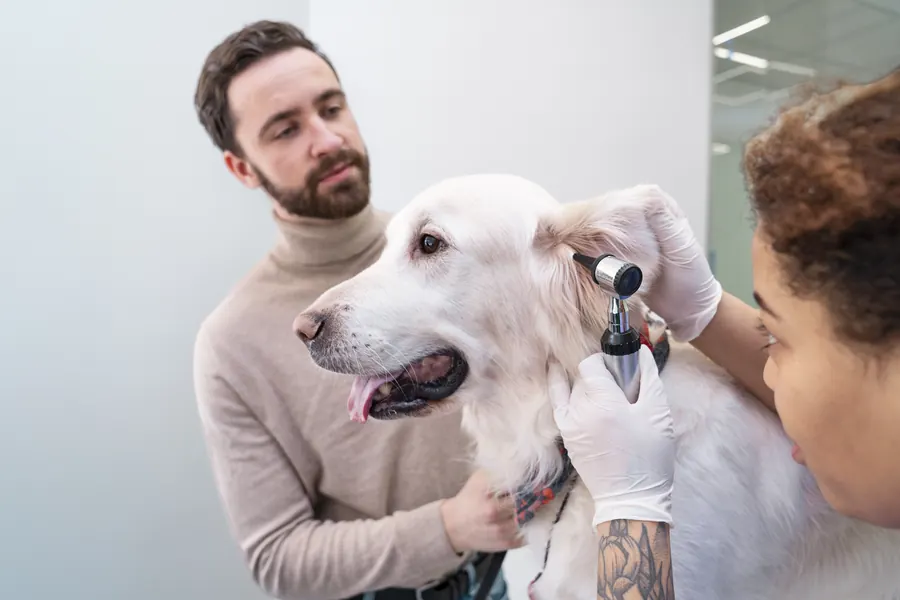
The vet takes a history and examines the eye and surrounding structures. Both eyes are checked even if only one has symptoms. General health is also assessed for signs of systemic disease. Assessing vision and eye reflexes helps identify more serious eye disease.
A Schirmer tear test measures tear production to investigate dry eye. Fluorescein staining checks for breaks in the corneal surface. Pressure inside the eye is measured to assess glaucoma and internal eye inflammation. A slit lamp helps examine the conjunctiva, cornea and front of the eye.
A foreign body may hide deep in conjunctival folds or behind the third eyelid. Eyelid position and hairs rubbing against the eye are checked. A local lump or unusual swelling may require a cell sample or biopsy. If obstructed tear drainage is suspected, the tear duct can be investigated by flushing.
Fluorescein dye can also help assess tear duct patency when needed.
Samples and assessment of allergic conjunctivitis
When bacterial inflammation is suspected, sampling helps confirm the diagnosis. A conjunctival cell sample can help assess the cause of inflammation. Bacterial culture may be combined with antimicrobial susceptibility testing. Allergic conjunctivitis is diagnosed by excluding other causes and identifying compatible clinical findings.
Monitoring allergic inflammation may involve grading six eye signs separately. Signs can be scored from zero to three, from absent to severe. This helps describe changes between visits. Owners' observations of itching at home also inform assessment.
Small lymphoid follicles normally occur on the back surface of the third eyelid. Enlarged follicles look like translucent bumps on the conjunctiva. When allergy is suspected, the severity of any atopic skin symptoms is also assessed.
Finding follicles alone does not establish allergy as the cause of eye inflammation.
Treatment
Treating the source of irritation
The vet chooses treatment according to the identified cause. A foreign body found in the eye is removed. An eyelid defect or eyelash problem causing rubbing may need surgery. Dry eye is treated with medicines supporting tear production and lubricants.
Exposure to irritants and, where possible, allergens is reduced. Rinsing with a solution intended for eyes may help remove irritating material. A lubricating gel can form a protective barrier between irritants and the eye's surface.
Medication depends on the findings
Antibiotics are not the standard treatment for every dog with conjunctivitis. A topical antimicrobial may be prescribed for confirmed or strongly suspected bacterial inflammation. Bacterial inflammation can persist despite medication if another predisposing cause remains untreated. For allergic conjunctivitis, the vet may use a topical allergy medicine or medication that suppresses inflammation.
Corticosteroid eye drops require the absence of a corneal ulcer. Long-term topical corticosteroid use carries a risk of corneal complications. Treating wider allergic disease may also ease eye symptoms. When needed, treatment is planned with a vet experienced in ophthalmology or dermatology.
Recovery from follicular conjunctivitis
The follicles are part of a reaction in the conjunctiva's lymphoid tissue. Some young dogs have fewer symptoms as immune tolerance develops. There is no reliable evidence that mechanical removal of the follicles is beneficial. Scraping can worsen inflammation.
A clinical follow-up of follicular conjunctivitis included 153 dogs and 276 eyes. The young group comprised 83 dogs under 18 months old. The adult group comprised 70 dogs aged at least 18 months. At one month, symptoms had resolved in 100 of 124 adult-group eyes, or 80.64%. In the young group, the corresponding result was 94 of 152 eyes, or 61.84%.
Medication choice depended on symptom severity. A one-month outcome does not describe every dog's future disease course. Severe or recurrent eye inflammation requires monitoring and reassessment of the underlying cause.
Prevention
A protective collar may prevent damage to the eyelid or eye surface in a dog rubbing the eye vigorously.
Reduce eye exposure to smoke, dust and harsh chemicals. Avoiding a known allergic trigger can help manage symptoms. A hair or eyelid defect continually rubbing the eye is treated to reduce recurrent irritation. Continuing dry-eye treatment protects the surface from repeated drying.
Vaccination helps prevent some eye symptoms associated with systemic infections. Repeated eye redness should be investigated even if it sometimes improves.
Important for dog owners
Do not restart medication from a previous eye problem on your own. The same outward symptom may have a different cause this time. Eye pain or a change in vision requires prompt examination.
Record whether symptoms started in one or both eyes, what the discharge looks like and when your dog rubs the eyes. Note any skin symptoms, new environmental exposures and eye products used. A short video of rubbing or squinting at home can be useful at the consultation.
Eye itching does not always appear as a similar skin rash around the eyes. In the group of 122 allergic dogs, symptoms were equally severe in both eyes in 73%. The remaining 27% had different severities between eyes. Changes in the less affected eye are therefore monitored too.
Follow the vet's treatment and follow-up instructions. Contact the practice again if the eye does not settle, symptoms return or you cannot administer the medication. Sudden deterioration in vision, increasing pain or cloudiness needs urgent assessment.
Frequently asked questions
Does conjunctivitis always need an antibiotic?
No, canine conjunctivitis is often caused by allergy or environmental irritation. A topical antibiotic is chosen when a bacterial infection warrants it. Any underlying dry eye or hair rubbing against the eye also needs treatment. Sampling can help confirm a bacterial diagnosis.
Can I use old eye drops on my dog?
Medication prescribed for a previous episode may be unsuitable or harmful if a different disease is causing the current redness. For example, a corneal ulcer must be excluded before corticosteroid drops are used. The cause of a red eye is therefore investigated by a vet before medication is chosen.
Does yellowish eye discharge always mean bacterial infection?
Discharge colour is not enough to identify the precise cause of inflammation. Dogs with allergic conjunctivitis can also have mucoid or mucopurulent discharge. However, bacteria may be involved secondarily. Sampling can help confirm a bacterial diagnosis.
Why does my dog's conjunctivitis keep returning?
Recurrence may be associated with dry eye, allergy or a structure continually rubbing the eye's surface. Medication from the previous episode may not address this underlying cause. With recurrent problems, further investigations may include a tear test, sampling or assessment by a vet with ophthalmic expertise.
How quickly does conjunctivitis improve?
Recovery depends on the cause and severity of inflammation. In follicular conjunctivitis, symptoms had resolved at one month in 100 of 124 adult-group eyes, or 80.64%. This is not a general recovery time for all conjunctivitis. Dry eye or atopic disease may need lifelong symptom management.
Sources
- Koiran sidekalvontulehdus, Ruokavirasto, accessed 2026-11-06.
- The Conjunctiva in Animals, Merck Veterinary Manual, accessed 2026-11-06.
- Eyes on Fire: Managing Conjunctivitis in Dogs, University of Illinois College of Veterinary Medicine, accessed 2026-11-06.
- Diagnostic approach and grading scheme for canine allergic conjunctivitis (2023), BMC Veterinary Research / PubMed Central, accessed 2026-11-06.
- Conjunctivitis in dogs, PDSA, accessed 2026-11-06.
- Conjunctivitis in Dogs, VCA Animal Hospitals, accessed 2026-11-06.
- Overview of Ophthalmic Emergencies in Small Animals, Merck Veterinary Manual, accessed 2026-11-06.
- Follicular conjunctivitis in dogs: A retrospective study (2007–2022), Veterinary Ophthalmology, accessed 2026-11-06.
This information does not replace a visit to a vet. In an emergency, contact your nearest emergency vet: find a vet (RCVS).