
Dog diseases · Eyes, ears and mouth
Ear mites in dogs: symptoms, spread and treatment
The ear mite, Otodectes cynotis, is an external parasite living in a dog's ear canal. Infestation can cause itchy outer ear inflammation. A dog can also catch ear mites from a cat living in the same home.
When to see a vet urgently
Arrange a veterinary appointment if your dog repeatedly scratches their ears or shakes their head.
- Contact an emergency vet immediately if the ear is very painful and your dog will not allow their head to be touched.
- Seek emergency care if your dog staggers so badly that they cannot remain standing.
- Contact an emergency vet if your dog's general condition deteriorates rapidly alongside ear symptoms.
- Heavy bleeding from the ear or its skin requires emergency care.
- If your dog suddenly develops a head tilt or one side of their face droops, contact your vet the same day.
Overview
An ear mite measures about 0.3–0.4 mm long. During otoscopy, it may appear as a moving white dot. It lives on the ear canal's skin surface, feeding on skin cells and tissue fluid. It remains on the surface rather than burrowing into the skin. Dogs can become infested with ear mites. The female attaches eggs to skin or hair, so developing mites remain on the host animal's surface. A fertilised female usually lays 15–20 eggs during her life. The larva hatching from an egg passes through 2 nymphal stages before becoming an adult.
Development from egg to adult takes about 3 weeks. The complete cycle from egg to the next generation's egg takes approximately 18–28 days. An adult ear mite is estimated to live for up to about 8 weeks.
Causes
Ear mites most commonly spread through close contact with another animal. Besides dogs and cats, they can live on ferrets and foxes. Infestation can also spread through shared bedding or grooming equipment. A mite can migrate from the skin into the ear canal. It can also move between the same dog's ears. The parasite can pass directly to a new host because it needs no intermediate host for development.
Mite movement and feeding irritate the ear canal's skin. A dog can become sensitised to mite secretions, so even a small number causes intense itching. The skin reaction to these secretions can develop into chronic ear canal inflammation. Visible discharge forms when shed skin cells mix with earwax, blood and mite faeces.
Risk factors
Infestations occur in adult dogs too, although they are often seen in young animals. Puppies can be exposed through their mother while nursing. In closely housed groups of dogs or cats, mites can spread rapidly between animals. A pet with mild or no symptoms can carry ear mites, so the source may initially go unnoticed.
Floppy ears are one factor predisposing dogs to outer ear inflammation. However, there is no firm evidence linking ear shape specifically to ear mite infestation.
In a Greek otitis study, ear mites were the primary cause of inflammation in 7 of 100 dogs. At a Brazilian dermatology clinic, mites were found in 15 of 250 dogs (6%) presented for reasons other than ear symptoms. At Albanian small animal practices, 602 pet dogs were examined and 2.8% had ear mites.
Typical symptoms
- Your dog scratches the ear because the canal is itchy.
- Your dog may rub the ear to try to relieve itching.
- Ear irritation causes repeated head shaking.
- Dry, crumbly, dark discharge resembling coffee grounds may collect in the canal.
- Inflammation can make the inner ear flap or visible canal red.
- Scratching can break the ear flap's skin.
Discharge may also be waxy or more liquid. Some infested dogs have no abnormal visible ear discharge. A sensitised dog may itch intensely despite having few mites. Parasites are sometimes found outside the ears, for example on the neck, around the tail or over the lower back. Infestation can affect one or both ears. In a group of 24 naturally infested dogs, mites were visible in both ears in 23.
Complications and consequences
Mite-induced otitis can be accompanied by bacterial overgrowth in the irritated canal. Yeast infection can also worsen symptoms. Scratching and head shaking can cause an aural haematoma. This is a collection of blood within the ear flap that makes it swell. The swollen flap may cover part of the canal opening. Longstanding inflammation can thicken the canal's skin enough to narrow it. Middle ear infection may also develop with chronic outer ear infection. Middle ear inflammation can cause hearing loss or pain when opening the mouth. Inflammation extending into the inner ear can affect balance.
Diagnosis at the vet
Examining the ears and taking samples
Alongside symptoms, your vet asks about close contact with other animals. They also assess skin signs elsewhere that may suggest conditions such as allergy. Your vet evaluates canal skin, the amount of discharge and, where possible, eardrum condition. Heavy discharge or swelling may obscure the eardrum during routine otoscopy. A very painful ear can be examined under sedation.
An ear discharge sample is collected before cleaning the canal. Discharge mixed with liquid paraffin is examined microscopically for live mites or eggs. Features such as legs extending beyond the body's edge help identify the mite. A stained discharge sample can be checked for bacteria, yeasts and inflammatory cells.
Why might a sample be negative?
Mites can be hard to detect when hidden beneath thick purulent discharge. If needed, your vet can collect wax with a small scoop-like instrument called a curette for microscopy. Sampling methods were compared in 30 ears with confirmed infestation. The study included 5 dogs and 12 cats. Routine otoscopy detected mites in 20 of 30 ears (67%). Curette samples revealed mites in 28 of 30 ears (93%). Cotton bud samples revealed them in 17 of 30 ears (57%). Combining otoscopy with curette sampling identified 100% of the study infestations, compared with 86% for otoscopy combined with cotton bud sampling.
In a separate canine study, video-otoscopy and discharge microscopy both detected mites in the same 41 of 69 ears examined. Conventional otoscopy detected mites in 27 of 69 ears in that study. If no mites are found, your vet investigates other causes of otitis, such as allergy or a foreign body. A chronically narrowed canal may need video-otoscopy under general anaesthesia for closer examination. Examining an unaffected-looking pet in the same household can sometimes help identify the source.
Treatment
Antiparasitic treatment and care of the inflamed ear
Infestation is treated with a medicine effective against ear mites, chosen by your vet. A systemic product can target mites living outside the ears too. Your dog's age and the severity of inflammation affect product selection. Some products are less effective against eggs than mobile mites. Any need for repeat treatment depends on the product and follow-up findings.
Discharge is removed because it can prevent topical medicine contacting the skin. Eardrum condition influences the choice of a safe cleaner and ear medicine. Treatment of concurrent bacterial or yeast infection is selected using the ear sample. If rod-shaped bacteria are seen or inflammation recurs, culture may help select an effective antimicrobial. Large numbers of microbes alone, without inflammatory cells, do not usually require antimicrobial treatment.
Response and follow-up examination
A field study at 17 veterinary practices compared imidacloprid combined with moxidectin against selamectin in pet dogs. In multi-dog households where several dogs met the study's mite-count requirement, one dog was selected for outcome assessment. At the 28-day check, mites were no longer detected in 71% of the first group and 69% of the selamectin group. On study day 56, the corresponding mite-free proportions were 82% and 74%. In another study, the geometric mean mite count in fluralaner-treated dogs at 28 days was 99.8% lower than in controls. On that day, flushing samples still contained live mites although none were visible during otoscopy of treated dogs. The treated dogs had less wax at 28 days, but some remained.
Follow-up assesses whether canal inflammation has resolved. Itching may improve before inflammation has fully settled. The ears can be rechecked within 30 days of antiparasitic treatment.
Prevention
When one pet has ear mites, treating household dogs and cats simultaneously helps prevent another cycle of infestation. Shared bedding and grooming equipment should also be cleaned because mites can spread on them. Off the animal, mites survive longer in cool than warm conditions. Ear mites collected from cats survived for up to 15–17 days at 10°C in a laboratory. Relative humidity in that experiment was 95%. At 34°C, mites in the same study survived for up to 5–6 days. In an experiment outside the laboratory, the longest observed survival without a host was 12 days at temperatures ranging from 12.3 to 14.2°C.
Important for dog owners
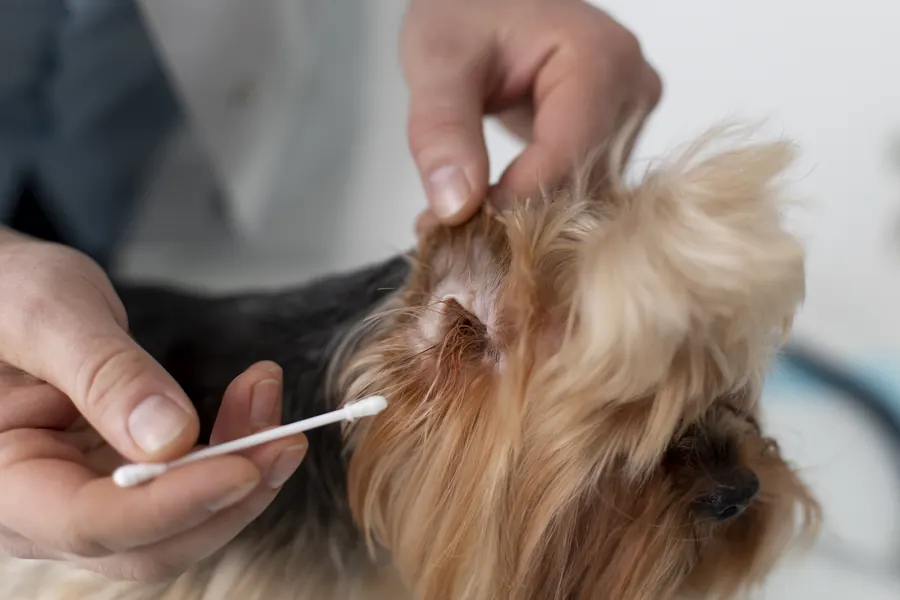
Tell your vet if cats, ferrets or other dogs live at home because infestation can spread between species. Do not start using drops left over from a previous ear infection on your own initiative. Human ear drops are unsuitable for dogs without veterinary assessment. Do not clean ears with vinegar mixtures, which can increase swelling and discharge. A cotton bud can push material deeper into the canal. If an ear sample is planned, leave the canal uncleaned before the appointment.
If your vet has advised cleaning at home, gently wipe visible discharge with a cotton pad. Stop cleaning if your dog seems painful. If hearing deteriorates or your dog starts staggering after ear drops, stop the topical treatment and contact your vet.
Frequently asked questions
Does dark ear discharge always mean ear mites?
Discharge resembling coffee grounds is consistent with ear mites. Similar discharge can occur in an ear inflamed for another reason. In dogs, outer ear inflammation may result from allergy or an ear foreign body, for example. Your vet confirms infestation by identifying a mite in the ear or discharge sample using otoscopy or microscopy.
Can my dog catch ear mites from a cat without symptoms?
A cat can carry ear mites without visible itching or other ear symptoms. Close contact with an infested animal can transfer mites to your dog. Treatment is therefore planned simultaneously for all dogs and cats in the household.
Can mites affect only one ear?
Mites may be found in one ear even if none are detected in the other during examination. They can move over the skin and migrate between the same animal's ears. Your vet can examine both ears and sample each if needed.
Is ear cleaning enough to treat mites?
Cleaning removes discharge but does not usually eliminate all your dog's ear mites. Some may be on skin outside the ear canal. A suitable antiparasitic medicine is used, and exposed household animals are treated too.
Can a dog's ear mites spread to people?
Isolated human infestations have been described in households where a pet had ear mites. These rare cases have involved itchy bumps and sometimes small skin blisters. Gloves can be worn when handling an infested animal's ears to help prevent this rare human infestation.
Sources
- Korvapunkki koiran korvatulehduksen aiheuttajana, Suomen Eläinlääkärilehti, accessed 2026-11-07.
- Control of Ectoparasites in Dogs and Cats: GL3, seventh edition (2022), ESCCAP, accessed 2026-11-07.
- Otodectes cynotis, Western College of Veterinary Medicine, accessed 2026-11-07.
- Otodectic Mite, Companion Animal Parasite Council, accessed 2026-11-07.
- Mitä on päivystyshoito, Helsingin yliopisto, accessed 2026-11-07.
- Koiran korvatulehdus, Eläinklinikka Saari, accessed 2026-11-07.
- Ulkokorvan tulehdus koirilla, Ruokavirasto, accessed 2026-11-07.
- Otitis Externa in Animals, Merck Veterinary Manual, accessed 2026-11-07.
- How to Clean Your Dog’s Ears, Cornell University College of Veterinary Medicine, accessed 2026-11-07.
- Otitis Media and Interna in Animals, Merck Veterinary Manual, accessed 2026-11-07.
- Ear Infections and Otitis Externa in Dogs, MSD Veterinary Manual, accessed 2026-11-07.
- Efficacy of fluralaner against Otodectes cynotis infestations in dogs and cats, Parasites & Vectors, accessed 2026-11-07.
- Field efficacy of a combination of afoxolaner, moxidectin and pyrantel pamoate against natural infestation with Otodectes cynotis in dogs, Parasites & Vectors, accessed 2026-11-07.
- Korvatulehdus, Pyynikin eläinlääkärit, accessed 2026-11-07.
- Clinical evaluation of the safety and efficacy of 10% imidacloprid + 2.5% moxidectin topical solution for the treatment of ear mite (Otodectes cynotis) infestations in dogs., Veterinary parasitology / Europe PMC, accessed 2026-11-07.
- Comparison of three methods for the diagnosis of otoacariasis due to Otodectes cynotis in dogs and cats., Veterinary dermatology / Europe PMC, accessed 2026-11-07.
- Otodectes cynotis (Acari: Psoroptidae): examination of survival off-the-host under natural and laboratory conditions., Experimental & applied acarology / Europe PMC, accessed 2026-11-07.
- Aetiology of canine otitis externa: a retrospective study of 100 cases., Veterinary dermatology / Europe PMC, accessed 2026-11-07.
- Video otoscopy as a diagnostic tool for canine otoacariasis., Revista brasileira de parasitologia veterinaria = Brazilian journal of veterinary parasitology : Orgao Oficial do Colegio Brasileiro de Parasitologia Veterinaria / Europe PMC, accessed 2026-11-07.
- Parasites and vector-borne diseases in client-owned dogs in Albania: infestation with arthropod ectoparasites., Parasitology research / Europe PMC, accessed 2026-11-07.
- Disorders of the Outer Ear in Dogs, Merck Veterinary Manual, accessed 2026-11-07.
This information does not replace a visit to a vet. In an emergency, contact your nearest emergency vet: find a vet (RCVS).