
Dog diseases · Skin and coat
Infected wounds in dogs: signs and treatment
An infected wound may be painful, swollen or foul-smelling, or discharge pus. Infection can extend from the skin into deeper tissues. Treatment involves veterinary cleaning and removal of dead tissue if needed.
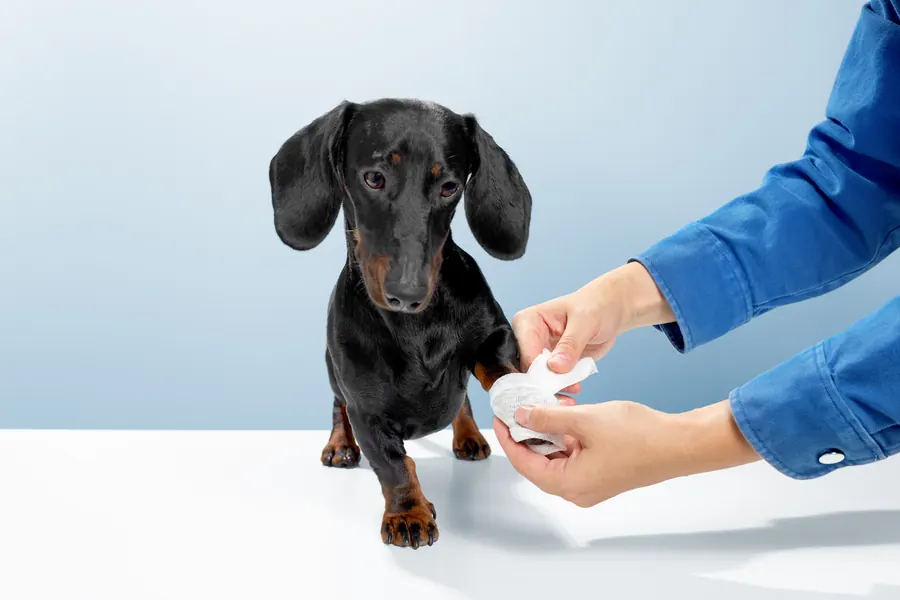
When to see a vet urgently
Contact your vet if a wound has pus, an unpleasant smell, increasing swelling or pain.
- Severe pain requires an emergency assessment.
- Seek emergency care if the wound bleeds heavily.
- Rapid deterioration in your dog's general condition requires immediate help.
- Breathing difficulty needs immediate treatment.
- A body temperature over 40°C requires an emergency assessment.
Even a small bite wound needs veterinary assessment because a deep cavity may remain beneath the skin.
Overview
Infection can develop in an accidental injury or a surgical wound. Superficial infection is confined to skin or subcutaneous tissue. Deep infection can extend into muscle and its surrounding fascia. After surgery, infection may also involve an operated organ or body cavity.
In one northern European hospital study from 1999–2001, 11% of small animal surgical wounds became infected. This was an older teaching-hospital study in which complex patients may have increased the infection rate.
Normal healing progresses through inflammation, growth of repair tissue and scar maturation. The initial inflammatory response also starts removing damaged cells and dirt. A properly closed incision can develop a new surface epithelial layer within 48 hours.
Causes
Bacteria entering damaged tissue
A puncture wound can carry bacteria deep into tissues. In a bite, bacteria from the dog's mouth enter the wound. A small skin opening can conceal extensive bruising and damaged tissues.
Dead tissue and retained foreign material reduce tissue resistance to bacteria. Dead space beneath the skin and fluid collecting in it can increase infection risk. Licking or scratching can damage a wound and introduce bacteria.
Excessive tension on wound edges can delay healing and cause reopening. In some crush injuries, skin initially looks intact despite damaged circulation. Tissue death may then develop only in the days after injury.
Persistent infection and biofilm
Bacteria can form a biofilm: a community surrounded by a protective layer they produce. Biofilm can shield bacteria from immune defences and antimicrobials. It can also form on suture material or a bone fixation plate. Biofilms have been associated particularly with persistent wound and surgical site infections.
Risk factors
Healing slows when circulation and oxygen supply to the injured area are impaired. An overly tight bandage can reduce tissue oxygenation. A haematoma or fluid collecting in the wound cavity can also hinder oxygen supply. Obesity can impair circulation and suture holding strength in fatty tissue.
Anaemia reduces tissue oxygen delivery and may delay healing. Malnutrition can interfere with repair tissue formation. Diabetes and hyperadrenocorticism can reduce resistance to wound infection. Corticosteroid medicines can slow the proliferation of capillaries and wound-repairing cells.
Uraemia associated with kidney disease can slow formation of granulation tissue, the new connective tissue filling a wound, and reduce collagen quality. An immobile or paralysed dog is vulnerable to pressure sores when the same area remains pressed against a surface.
Typical symptoms
A fresh surgical wound may show mild redness as healing starts. Slight intermittent bloody seepage can occur during the first 24 hours. Thick, foul-smelling discharge with swelling and pain suggests a change needing examination.
- The wound's surroundings become red or swollen.
- The area feels warmer than usual.
- The wound produces pus or foul-smelling discharge.
- Your dog finds it tender or starts limping.
- Your dog becomes listless or lethargic.
- Appetite decreases or a fever develops.
With deep surgical wound infection, the wound may open spontaneously.
Surgical wound edges should normally meet, and the surface should be clean. Loose stitches or continual fluid leakage warrant immediate contact with your vet.
Complications and consequences
In the worst cases, untreated bite wound infection can lead to life-threatening sepsis. Pus accumulating beneath the skin can form an abscess. A surgical site infection may require another operation.
Multidrug-resistant bacteria were found in 19 dogs in a study of 80 infected patients. Scarring of a large open wound near a joint can restrict movement.
Signs of biofilm-associated infection can return when antibiotic treatment ends. Closing a wound too early can predispose it to deep infection or reopening.
Diagnosis at the vet
Examining the whole dog and the wound
Your vet first checks general condition and any life-threatening injuries. A wide area of coat may be clipped to find every bite mark. A painful wound can be examined under sedation. The opening may be enlarged to establish its depth and tissue damage.
Flushing helps reveal the underlying tissues. Examination also assesses whether skin at the edges is viable or dead. Blue-black, leathery or white skin may be non-viable.
Bacterial sampling and infection depth
An infected wound is sampled for culture and antibiotic susceptibility testing if needed. Culture helps identify the organism and target medication. A routine surface sample may be negative if bacteria are in a biofilm.
Investigating deep infection may require repeat surgery, tissue examination or imaging. In one northern European surgical wound surveillance scheme, the usual monitoring period is 30 days. If an implant remains in the tissues, this scheme uses a 1-year period.
Antibiotic susceptibility tests usually assess free-living bacteria. Bacteria within biofilms may differ in susceptibility from routine culture results.
Treatment
Cleaning, pain relief and medication
Your vet chooses treatment according to location, tissue damage and infection. Flushing removes dirt and reduces bacterial numbers in the tissue. Dead tissue and foreign material are surgically removed as needed. If tissue viability becomes clear only gradually, more than one debridement procedure may be needed. Wound pain is treated with prescribed pain relief.
An infected wound may require an oral or injectable antibiotic. For persistent soft tissue infection, medication is combined with cleaning and topical care if needed. Biofilm-associated implant infection may require removal of a fixation plate or other implant once the bone has united.
Excessive flushing pressure can drive dirt deeper into healthy tissue. Detergent-containing surgical skin scrubs are unsuitable for direct wound use because they damage tissue.
Open wound management, drains and closure
A heavily infected wound may be managed open to allow discharge to escape. A drain is a tube placed in the wound to direct fluid out. It is removed once fluid decreases and no longer looks purulent.
A minimally contaminated wound can sometimes be closed 24–72 hours after cleaning. A heavily infected wound may need longer open management before closure. Healing while open usually takes longer and can leave a hairless scar. A healing wound fills with new, blood-vessel-rich granulation tissue. In a healthy wound, connective tissue cells begin appearing about 3 days after injury.
Dressings are selected according to the healing stage and tissue needs. An infected wound may need dressing changes 1–2 times daily. New granulation tissue and surface epithelium are easily damaged by rough handling.
Choosing dressings and drains
A dressing maintaining suitable moisture supports the body's own cleaning and repair tissue growth. A dried-out surface slows new skin formation. Removing an adherent dressing can hurt and remove healthy repair cells. Polyurethane foam, for example, can absorb discharge and maintain a moist environment in a cleaned wound. In some situations, this dressing can be changed every 3–7 days.
Negative-pressure therapy is used for some open wounds to remove fluid and support closure. An active closed drainage system reduces the risk of infection ascending from outside compared with a passive drain. Drain fluid can also be examined by cytology.
The effect of the overall care approach
A clinical trial comparing wound-care approaches enrolled 58 dogs. After conventional care, 4 of 32 wounds became infected (12.5%). After simplified care, 10 of 25 became infected (40%). The trial stopped early because of complications in the simplified-care group. Differences between the approaches included flushing, suturing technique and antibiotic treatment.
Prevention
A sterile, lint-free dressing helps prevent further contamination during transport. A protective collar or garment suited to the wound's location prevents licking. Calm activity helps avoid excessive stretching of an incision. Initial exercise restriction for a surgical wound is usually 7–14 days.
Veterinary hand hygiene and careful aseptic technique reduce surgical site infection risk. Routine preventive antibiotics are not recommended for ordinary clean soft tissue surgery. Unnecessary antibiotics can alter gut microbes and select resistant bacteria.
Prevent pressure sores in an immobile dog by changing position and providing sufficiently soft bedding. Cleanliness and adequate nutrition are also part of prevention. Protect a paw bandage from outdoor moisture and dirt.
Important for dog owners
Check an uncovered surgical wound at least twice daily. Contact your vet if discharge thickens or starts smelling, or pain and swelling increase. Replace a wet or dirty wound pad with a clean one.
Keep a bandage clean and dry and monitor the skin above and below it. Swollen toes or colour changes warrant contact with your practice. Do not put alcohol or hydrogen peroxide into an open wound: they can damage tissue and delay healing. Use only creams and cleaners your vet has approved for that particular wound.
An open wound can be cleaned with lukewarm water if suitable wound irrigation fluid or saline is unavailable. Keep a closed incision dry and do not bathe your dog during healing. Follow your dog's individual wound-care and exercise instructions because extensive surgery may require several weeks of recovery.
Frequently asked questions
Can my dog care for a wound by licking it?
Licking can damage the wound and introduce infection. A collar or suitable recovery suit prevents access. Protection for an open wound is selected according to location so your dog cannot lick or chew the damaged area.
Is all wound discharge pus?
An incision may produce small amounts of clear, thin tissue fluid early in healing. A fresh surgical wound may also seep a little blood during the first 24 hours. Thick, foul-smelling discharge and increasing pain or swelling need veterinary assessment.
Why is an infected wound not stitched closed immediately?
Immediate closure is not always suitable for a heavily contaminated or deeply infected wound. Open management allows cleaning and drainage. Once infection and contamination are controlled, your vet may consider later closure.
Does every wound need antibiotics?
Preventive antibiotics are not routinely recommended for clean soft tissue surgery. An already infected wound is a different situation and may need antibiotics. Selection is guided by examination and, when needed, culture and susceptibility testing.
When are stitches removed, and when is the wound strong again?
Removable skin stitches are usually taken out 10–14 days after surgery. Scar strengthening continues much longer, for up to 2 years. Most healed wounds nevertheless remain about 15–20% weaker than the original tissue. Return to exercise therefore follows instructions appropriate to the extent of surgery.
Sources
- Mitä on päivystyshoito, Helsingin yliopisto, accessed 2026-11-07.
- Initial Wound Management in Small Animals, MSD Veterinary Manual, accessed 2026-11-07.
- Management of Specific Wounds in Small Animals, MSD Veterinary Manual, accessed 2026-11-07.
- Care of Open Wounds in Dogs, VCA Animal Hospitals, accessed 2026-11-07.
- Koiran puremahaava, Eläinklinikka Tsemppi, accessed 2026-11-07.
- Lemmikin haavanhoito, Eläinlääkäriasema Lempiellit, accessed 2026-11-07.
- Bandage and Splint Care in Dogs, VCA Animal Hospitals, accessed 2026-11-07.
- Drains in Wound Management of Small Animals, Merck Veterinary Manual, accessed 2026-11-07.
- Factors that Interfere with Wound Healing in Small Animals, Merck Veterinary Manual, accessed 2026-11-07.
- Leikkaushaavainfektioilmoitus, Helsingin yliopisto, accessed 2026-11-07.
- Leikkaushaavainfektiot Yliopistollisen eläinsairaalan pieneläinklinikalla 1999–2001, Suomen Eläinlääkärilehti, accessed 2026-11-07.
- ENOVAT 2025 guidelines for surgical antimicrobial prophylaxis in dogs and cats, Journal of Small Animal Practice / ENOVAT, accessed 2026-11-07.
- Bacterial Biofilms & Their Role in Common Veterinary Infections, Clinician’s Brief, accessed 2026-11-07.
- Care of Surgical Incisions in Dogs, VCA Animal Hospitals, accessed 2026-11-07.
- Multidrug-resistant wound infections are associated with greater mortality, larger costs, and longer hospitalizations than susceptible infections in canine patients., Journal of the American Veterinary Medical Association / Europe PMC, accessed 2026-11-07.
- Assessment of Wound Healing Complications With a Lower Cost Outpatient Wound Management Protocol: A Pragmatic Randomized Clinical Trial in Dogs., Journal of veterinary emergency and critical care (San Antonio, Tex. : 2001) / Europe PMC, accessed 2026-11-07.
- General Principles of Wound Healing in Small Animals, Merck Veterinary Manual, accessed 2026-11-07.
- Notions, Potions or Lotions? Acute Wound Management in Dogs and Cats, WSAVA 2013 Congress / VIN, accessed 2026-11-07.
This information does not replace a visit to a vet. In an emergency, contact your nearest emergency vet: find a vet (RCVS).
More on this topic: Skin and coat
- Acne in dogs: chin spots and treatment
- Alopecia X and seasonal flank alopecia in dogs
- Paw pad injuries in dogs: first aid and wound care
- Atopic dermatitis in dogs: itching, tests and long-term care
- Demodectic mange in dogs: Demodex mites and skin disease
- Fibrosarcoma in dogs: symptoms, diagnosis and treatment