
Dog diseases · Eyes, ears and mouth
Malocclusion in dogs: bite problems and treatment
Malocclusion means abnormal tooth or jaw positions affecting how the teeth fit together when the mouth closes. A common problem requiring treatment is a lower canine tooth pressing into the palate. Treatment aims to achieve a comfortable, functional bite.
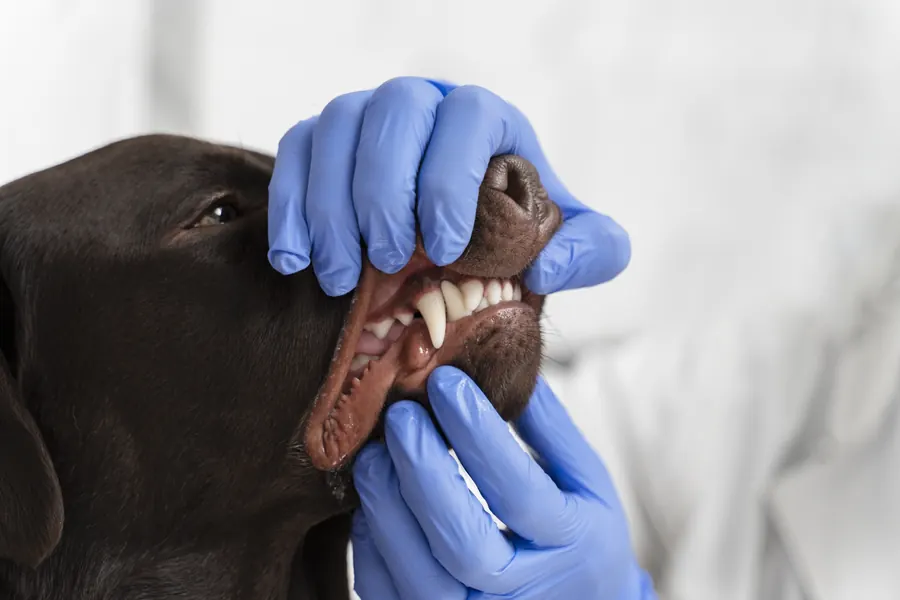
When to see a vet urgently
Arrange an assessment soon if your puppy's canine tooth presses into the gum or palate when the mouth closes. Contact an emergency vet immediately if your dog shows signs of an acute mouth injury or their condition deteriorates rapidly.
- There is heavy bleeding from the mouth.
- Your dog cannot close their mouth after an injury.
- The mouth is too painful for your dog to use normally.
- Breathing becomes difficult.
Overview
How do the teeth meet?
An adult dog's complete set contains 42 teeth. In a scissor bite, the tips of the lower incisors rest against the backs of the upper incisors. Viewed from the front, the upper incisors cover about 1/3 of the lower incisor crowns. The lower canine fits into the space between the outermost upper incisor and upper canine. Its tip is visible when the mouth is closed and remains clear of the upper gum and palate. The upper and lower premolars interlock.
Overbites, underbites and other bite problems
In dental malocclusion, or MAL1, the jaws have a normal front-to-back relationship, but one or more teeth are incorrectly positioned. In an overbite, or MAL2, the lower dental arch sits further back than normal relative to the upper jaw. In an underbite, or MAL3, it sits further forward than normal relative to the upper jaw. In MAL4 malocclusion, the jaws are asymmetrical relative to each other, for example from side to side. An open bite leaves an abnormal gap between the upper and lower teeth when the mouth closes.
In a level bite, the tips of the upper and lower incisors meet directly. In an incisor crossbite, a lower incisor sits in front of an upper incisor, although the rest of the bite may be normal.
Causes
Skeletal malocclusion can result from a mismatch in jaw length or width. Jaw length and tooth size are inherited traits. Several genes probably influence how the bite develops. Even parents with normal bites can produce a puppy with skeletal malocclusion. A bite injury in puppyhood can damage a developing permanent tooth so that it erupts in the wrong place. Infection in a broken baby tooth can also damage the permanent tooth before it erupts.
Dogs usually start replacing their baby teeth at 4–5 months of age. Permanent teeth are usually fully erupted by 7–9 months. If a permanent tooth erupts away from its correct position, the baby tooth's root may fail to resorb and the baby tooth remains in the mouth. A narrow lower jaw can cause the lower canine tip to hit the upper gum when the mouth closes. A lower canine tilted towards the tongue can worsen the bite problem caused by a narrow lower jaw.
Risk factors
In short-muzzled breeds, a short upper jaw can result in the breed's characteristic underbite. An underbite is typical of Boxers, for example. Retained baby teeth occur particularly in small breeds. Forward-tilted upper canines, sometimes called lance canines, are seen particularly in Shetland Sheepdogs and Chinese Crested Dogs.
When 297 puppies were examined at 8–12 weeks, 77 had malocclusion of their baby teeth. Underbites conforming to the breed standard were counted as normal bites in this puppy study. Across the whole puppy group, the prevalence of malocclusion did not differ significantly between pedigree dogs and crossbreeds.
In one northern European Cesky Terrier health survey in 2022, owners reported malocclusion in 12 dogs.
Typical symptoms
Mouth pain caused by malocclusion can be hard to recognise because your dog may still eat.
- The upper gum may show an indentation from a lower canine tip.
- There may be a wound on the palate where a tooth tip rubs.
- Your dog may seem more subdued than usual.
- Your dog may drool more than usual.
- Your dog may scratch their muzzle.
- With an asymmetrical bite, the midlines of the upper and lower incisors may not align.
- A severe canine tooth malposition can prevent the mouth from closing completely.
Incisor tips meeting edge to edge may be visible at the front of the mouth when the lips are lifted gently.
If the bite changes suddenly and your dog cannot eat, an injury such as a lower jaw fracture may be responsible.
Complications and consequences
Mouth wounds and tooth wear
A canine tooth repeatedly striking the palate can damage the oral lining. A deep palatal injury can create a fistula connecting the mouth and nasal cavity. With an underbite, the inner surface of a lower canine can wear down if the outermost upper incisor rubs against it. Rotated, crowded teeth predispose a dog to periodontitis, inflammation of the tooth-supporting tissues. Part of a forward-tilted upper canine crown may remain hidden beneath the gum, creating an abnormally deep gum pocket around it. Interlocking teeth on one side of a puppy's mouth can interfere with jaw growth asymmetrically.
Diagnosis at the vet
Assessing the bite and taking dental X-rays
Your vet can assess the bite and detect visible tooth damage while your dog is awake. From the front, they check whether the jaws and dental midlines are straight. From the side, they assess how the upper and lower teeth relate along the entire dental arch. A thorough oral and dental examination is performed under general anaesthesia. The dental chart records tooth malpositions alongside findings such as fractures and gum changes. The palate is checked for damage where a lower canine makes contact.
Before extracting a baby canine tooth, an X-ray can locate the developing permanent tooth. If a tooth is not visible, an X-ray establishes whether it is missing or has failed to erupt. When crown reduction is planned, the stage of root-tip development influences assessment of treatment for the tooth's internal tissues.
If malocclusion developed after an accident, CT helps establish the extent of a possible jaw fracture or jaw joint dislocation.
Treatment
Baby teeth in puppies
A baby canine digging into the palate can be extracted before the permanent tooth erupts, stopping pressure on the soft tissue. Extraction may release the dental interlock that is restricting jaw growth. The permanent bite is checked again once the adult teeth have erupted.
In a study monitoring enamel defects after extraction, puppies were 8–12 weeks old at the procedure. After their teeth changed, 28 of 74 puppies needed further treatment to prevent the permanent lower canine damaging the palate or gum (37.8%). In the same 74-puppy study, enamel defects were found in permanent teeth in 13 puppies following baby canine extraction (17.5%). Defects were found in 21 permanent canine teeth after a total of 143 baby teeth had been extracted (14.6%). In another follow-up of 17 puppies, 9 developed a normal adult bite (52.9%). Immediately after extraction, the tip that had been contacting soft tissue stopped injuring the mouth in all dogs in this 17-puppy study.
In the same 17-puppy follow-up, all 6 puppies with initially normal jaw proportions developed a normal permanent bite (100%). Among puppies with an overbite, 27.27% developed a normal permanent bite.
Orthodontic treatment of permanent teeth
For a mild canine malposition, a suitably sized ball selected by your vet may guide the tooth outwards. Progress with ball therapy can be assessed after about 3 weeks before deciding whether to continue. Orthodontic treatment of permanent canines can be considered soon after eruption, often at about 6–8 months of age. Crown extension requires enough space for the lower canine in the upper dental arch. An extension made from dental restorative material can guide the lower canine towards its intended space. An inclined plane attached to the upper jaw guides the lower canines outwards when the dog closes their mouth. A fixed appliance requires at least 2 general anaesthetics for fitting and removal.
An inclined-plane study followed 118 lower canine teeth in 72 dogs. The tooth moved into a position completely clear of tissue in 84 cases (71.2%). In 30 teeth, the tip still touched tissue but no longer injured it (25.4%). Malocclusion remained traumatic in 4 teeth after inclined-plane treatment (3.4%). Median treatment duration was 42 days, ranging from 11 to 174 days. During treatment, 37 inclined-plane appliances needed adjustment or replacement (31.4%). Mean treatment duration was 55 days with an overbite and 30 days with dental malocclusion. After appliance removal, 17 teeth relapsed at least partly into an abnormal position (14.4%). In a Norwegian crown-extension study, lower canines maintained a comfortable, functional position without further support in 56 of 72 dogs (77.8%).
To maintain a functional bite, 20.8% of dogs were left with a permanent crown extension of 1–2 mm.
A lance canine can be corrected with brackets attached to the teeth and an orthodontic wire if the tooth can be moved into a functional position.
Crown reduction or extraction
The crown can be shortened if there is insufficient space to move a lower canine safely. During reduction, your vet may perform a partial pulpotomy, aiming to keep the tooth alive. The first X-ray check of a shortened tooth is often performed after about 6 months, followed by annual checks. A tooth damaging oral tissue can also be extracted. The long lower canine root forms part of the lower jaw's supporting structure, particularly in small dogs. Sometimes another tooth can be removed to create space for the canine and preserve it. Wound healing may be checked 10–14 days after extraction.
Prevention
A puppy's bite should be assessed early because a baby tooth damaging soft tissues can interfere with normal jaw growth. Removing a retained baby tooth beside a permanent tooth may help the permanent tooth erupt into a more suitable position. Breeding should avoid pairings that could pass health-damaging malocclusion to offspring. Some breed clubs' breeding programmes set out specific recommendations about the bite and teeth.
Some Cesky Terrier breeding guidelines exclude dogs with severe malocclusion affecting welfare or malpositioned canine teeth.
Important for dog owners
Watch your puppy's teeth as they change: a baby tooth and its corresponding permanent tooth do not normally occupy the same space together. If a baby canine remains beside the permanent canine, have your vet examine the teeth. Tell your vet if your dog has had a blow to the jaw or baby teeth extracted previously. Give a dog wearing a fixed orthodontic appliance only chewing items permitted by your practice's instructions. Clean the teeth and appliance daily as your vet directs. At a check-up, your vet can assess whether a retainer is needed to prevent the tooth returning to its abnormal position.
Frequently asked questions
Does an underbite always need treatment?
An underbite is part of the usual conformation of some short-muzzled breeds, such as Boxers. It generally needs no procedure if the teeth neither rub against each other nor damage the gums. Your vet assesses harm using findings such as tooth wear and damage to the oral lining.
Why extract a canine baby tooth in a young puppy?
A baby canine hitting the palate or upper gum causes pain. Extraction can stop ongoing damage from the tip and release an interlocked jaw to allow growth. The position of the permanent teeth is assessed separately after the teeth have changed.
Can I notice a bite problem even if my dog eats?
Your dog may eat despite pain in the teeth or oral lining. An indentation from a tooth tip in the upper gum or palate may show that a lower canine is striking soft tissue. Your vet assesses whether the tissue is injured each time the mouth closes.
Can a lower canine tooth be saved?
A lower canine contacting tissue can sometimes be moved orthodontically into a position where its tip no longer injures the mouth. If there is insufficient space for the tooth, your vet may shorten its crown. Treatment of the shortened tooth may aim to preserve living pulp tissue.
Why check the bite after removing an appliance?
A corrected tooth may partly return to its previous abnormal position after a fixed appliance is removed. At follow-up, your vet checks whether the tooth is causing tissue damage again. If the tooth cannot maintain its position without support, your vet may assess the need for a retainer.
Sources
- Purentavirheet ja niiden hoito, Keski-Suomen eläinklinikka, accessed 2026-11-07.
- AVDC Nomenclature, American Veterinary Dental College, accessed 2026-11-07.
- Developmental Abnormalities of the Mouth and Dentition in Small Animals, Merck Veterinary Manual, accessed 2026-11-07.
- Tietopaketti koirien ja kissojen hammashoidosta, Anident, accessed 2026-11-07.
- Tietopaketti koirien ja kissojen hammashoidoista ja suukirurgiasta, Helsingin yliopisto, accessed 2026-11-07.
- Koirien pitoa koskevia uusia vaatimuksia, Ruokavirasto, accessed 2026-11-07.
- Mitä on päivystyshoito, Helsingin yliopisto, accessed 2026-11-07.
- Success of orthodontic treatment of linguoverted mandibular canine teeth using a direct inclined plane appliance, Frontiers in Veterinary Science, accessed 2026-11-07.
- Incidence of enamel defects on permanent canine teeth following extraction of linguoverted mandibular deciduous canine teeth in dogs, Frontiers in Veterinary Science, accessed 2026-11-07.
- Prevalence of Malocclusion of Deciduous Dentition in Dogs: An Evaluation of 297 Puppies, Journal of Veterinary Dentistry / Crossref, accessed 2026-11-07.
- Assessment of Extractions of Deciduous Mandibular Canine Teeth to Correct Linguoversion Malocclusion in 17 Dogs, Journal of Veterinary Dentistry / Center for Veterinary Dentistry and Oral Surgery, accessed 2026-11-07.
- A novel acrylic orthodontic device for treatment of linguoverted mandibular canine teeth in small dogs, Canadian Veterinary Journal, accessed 2026-11-07.
- Assessment of Temporary Crown Extensions to Correct Linguoverted Mandibular Canine Teeth in 72 Client-Owned Dogs (2012-2016), Journal of Veterinary Dentistry / Crossref, accessed 2026-11-07.
- Canine Malocclusion, MSPCA-Angell, accessed 2026-11-07.
- A Removable Orthodontic Appliance for Dogs, WSAVA World Congress / Veterinary Information Network, accessed 2026-11-07.
- Hammashoito, Eläinlääkäriasema Lillvet, accessed 2026-11-07.
- Koiran terveys, Suomen Kennelliitto, accessed 2026-11-07.
- Ceskyterrierin jalostuksen tavoiteohjelma 2025–2029, Ceskykerho, accessed 2026-11-07.
- Tietopankki: purentaviat, Eläinlääkäriasema Kamu, accessed 2026-11-07.
- Dentofacial Trauma in Small Animals, Merck Veterinary Manual, accessed 2026-11-07.
This information does not replace a visit to a vet. In an emergency, contact your nearest emergency vet: find a vet (RCVS).