
Dog diseases · Skin and coat
Nail fold inflammation in dogs: symptoms and treatment
Nail fold inflammation, or paronychia, affects the skin surrounding a claw. The base of an affected claw may become red and swollen. Treatment depends on whether inflammation involves a claw injury, bacterial infection or a wider skin condition, for example.
When to see a vet urgently
Arrange a veterinary appointment if your dog constantly licks a toe or nail fold swelling worsens.
- Seek emergency care if a claw bleeds heavily and pressure does not stop it.
- Contact an emergency vet immediately if your dog is in severe pain.
- Emergency care is needed if your dog's general condition deteriorates rapidly alongside paw symptoms.
- If the toe feels hot and the nail fold discharges foul-smelling pus, contact your vet the same day.
- A dog unable to stand needs an emergency assessment.
Overview
The nail fold forms a soft border around the claw's base. The outer claw consists of hard keratin. The quick is living tissue, unlike the keratin covering it. It contains nerves and blood vessels, so an exposed quick is sensitive to pain and bleeding.
Inflammation may be confined to the nail fold or form part of more extensive paw dermatitis. Nail fold inflammation and a split in the claw's keratin can affect the same toe. One inflamed claw may follow an injury, whereas changes in several claws prompt investigation of underlying disease too.
Causes
Injury and local inflammation
A bent or torn claw can damage tissue beneath its hard covering. After injury, bacteria can enter the claw and toe tissues. Persistent inflammation of a single claw may also be caused by a nail bed tumour. Chronic nail bed infection can involve several bacterial species. Staphylococci, for example, may be found in claw and nail fold discharge.
Allergy, yeast and disease affecting several claws
Atopic dermatitis can predispose nail folds to bacterial or yeast infection. Food hypersensitivity may also underlie secondary nail fold inflammation. Malassezia yeasts occur on healthy canine skin too, so their presence is assessed alongside skin symptoms. Demodex mite overgrowth, or demodicosis, can cause paronychia. Symmetrical lupoid onychodystrophy, or SLO, is a claw disease in which claws can shed on several paws. Nail fold irritation in SLO can relate to the claw damage itself or associated bacterial infection. Fungal claw infection can roughen the surface or soften its structure. With ringworm affecting a claw, red, hairless patches may appear elsewhere on the paws or muzzle.
Risk factors
An overlong claw can catch on a surface such as a grating and tear. An underlying condition can weaken claw keratin and predispose it to further injury. An older dog's claws may become dry and brittle, making them easier to break. Itching beside a claw can cause repeated paw licking or chewing. SLO may initially affect one claw, so the first injury can look like an ordinary accident.
SLO has been described particularly in dogs aged 2–6 years. In another SLO series, the mean age at onset was 7 years. In Bearded Collies, SLO susceptibility has been linked to the DLA region of the canine immune system's genes.
Typical symptoms
- Your dog repeatedly licks or chews the painful paw.
- Skin at the claw's base may become red or crusted.
- The nail fold or whole toe may swell and feel warm.
- Pus that may smell unpleasant can discharge beside the claw.
- Your dog may limp if bearing weight on the toe hurts.
- Yeast-associated inflammation may cause brown discharge or rusty-brown staining at the claw's base.
An injured claw may break, bend or remain attached in an abnormal position. In SLO, new claw damage can appear on all paws within 2–9 weeks of the first affected claw. A shed claw may expose a sensitive quick that hurts when touched. In SLO, claw keratin can detach without an obvious external injury. Bacterial infection in several claws can cause fever or lethargy.
Complications and consequences
The quick connects with the toe bone, so deep infection can spread from the claw into bone. Bone infection is called osteomyelitis. Severe osteomyelitis may require removal of the affected toe. A dog with a painful claw injury may avoid bearing weight and move less than usual. A claw growing after SLO may be uneven and brittle even once the worst inflammation has eased. New growth can split again if it is soft, brittle or abnormally shaped. Persistent inflammation may sustain paw pain after the initial injury has healed.
Diagnosis at the vet
Examining every paw
Your vet asks whether symptoms began suddenly, for example after a torn claw. All paws, claws and the rest of the skin are examined. When at least 2 claws are affected, possible causes include parasites, fungal disease and immune-mediated claw disease. A very swollen toe may be X-rayed to investigate bone infection or a tumour. If a single toe lesion does not improve with initial treatment, tissue sampling can help determine whether it is a tumour. Persistent swelling of one toe in an older dog may warrant investigation of a nail bed tumour.
In a series of 2,912 samples from removed toes and claws, 42.7% of lesions were classified as non-neoplastic. Of the non-neoplastic lesions, 92% were inflammatory. Tumours were identified in 1,528 samples in the same series. The series included only toes and claws that had been removed and submitted for tissue examination.
Cytology, culture and other skin tests
Cytology of nail fold discharge can assess bacteria, yeasts and inflammatory cells. Bacteria inside an inflammatory cell support a diagnosis of bacterial infection. Brown staining alone cannot establish yeast infection of a nail fold.
One study compared 3 ways of collecting nail fold cytology samples. Dogs were divided into 3 groups according to whether they were healthy or allergic and whether nail fold inflammation was visible. More extracellular cocci were found in dogs with both allergy and paronychia. Toothpick samples yielded more yeasts than tape or impression samples. They also yielded more extracellular cocci. Although yeasts were detected more often in allergic dogs, yeast numbers did not differ significantly between groups.
Culture and susceptibility testing help select medication for deep bacterial infection. Skin scrapings can look for Demodex mites if other skin changes surround the nail fold. Material from the claw's base or hairs plucked around it can be submitted for fungal culture if needed. SLO can often be recognised from symptoms and claw changes once other possibilities have been investigated. If food hypersensitivity is suspected, investigation may include a 6–8-week elimination diet. In typical SLO, assessment of claw appearance and previous symptoms may be sufficient without a nail bed biopsy.
Treatment
Local treatment and pain relief
The loose part of an injured claw may need removal to prevent further tearing of the nail bed. Sedation and local anaesthesia can be used when treating a painful claw injury. Pain relief may still be needed after the damaged part is removed. A bandage can protect the exposed nail bed from dirt after the procedure. Following removal of claw keratin, a light paw bandage may be used for up to 2 days if needed, as your vet advises. It can also reduce bleeding after the procedure.
The need for antibiotics depends on the extent of inflammation and examination findings. Deep bacterial nail bed infection may require a systemic antimicrobial. Your vet selects it using culture and susceptibility results. During treatment, they check whether bacterial nail fold infection has settled and whether care needs adjustment. If cytology identifies yeast overgrowth consistent with symptoms, mild inflammation can be treated with a topical antifungal.
Treating the underlying disease and recovery
When nail fold problems relate to allergy, treating local infection alone does not remove the predisposition caused by the skin disease. Initial SLO care focuses on pain and removal of partly detached claws if needed. Long-term treatment may be required if claw symptoms return when SLO treatment stops. A nail fold that is no longer painful on palpation is one sign of an adequate response. Attachment of new claw growth is monitored because nail bed inflammation may settle before the claw looks normal. In a small SLO treatment study, symptoms improved in 13 of 14 dogs. The study compared ciclosporin with a fatty acid supplement in dogs eating a diet high in omega-3 fatty acids. No statistically significant difference was found between treatment groups. Healthy study dogs' claws grew 0.7–2.1 mm per week, so new claw formation is assessed over time. A dog with SLO may retain abnormally shaped claws even when they are no longer painful.
Prevention
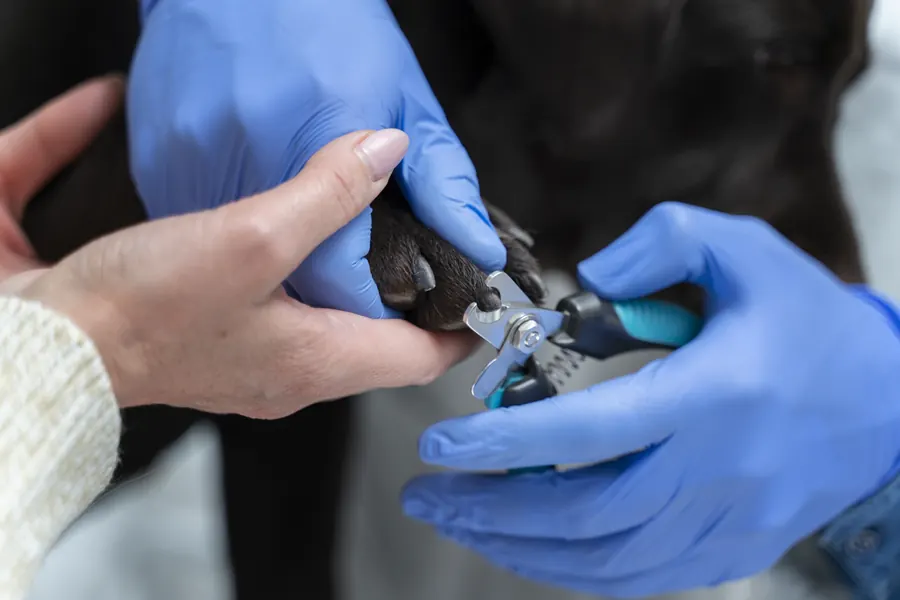
Keeping claws appropriately short reduces catching on surfaces such as gratings. Dewclaws should also be checked and trimmed regularly. Trim a little at a time to avoid cutting the blood-vessel-containing quick. Drying paws after walks reduces moisture in which yeasts and bacteria readily multiply. Practise claw handling from puppyhood by rewarding calm paw handling. Claws may wear down more slowly in winter, so their length may need closer monitoring. Sharp clippers designed for dogs reduce splitting during trimming.
Important for dog owners
Prevent licking of a painful claw before examination. Do not pull off a partly detached claw yourself: removal may require local anaesthesia or sedation. Check that a bandage applied by your vet stays clean and dry. Outdoors, a protective boot can shield it from moisture and dirt. Contact your practice if toes exposed beyond the bandage swell or change colour. A wet or dirty bandage is also a reason to contact the practice.
Frequently asked questions
Does a red nail fold always mean bacterial infection?
Redness and swelling indicate inflammation, which may also relate to claw damage or underlying claw disease. Cytology helps establish whether bacteria or yeasts are present. Culture may be used if deep infection is suspected.
Why does the vet examine the other claws?
A change in one claw can result from local injury or a tumour. Damage in other claws may reveal a disease affecting several paws. SLO, for example, may begin in one claw before affecting others.
Does a brown claw definitely mean yeast?
Malassezia-associated inflammation can stain a claw or paw rusty brown. Yeasts also live on healthy skin, so symptoms and cytology are assessed alongside colour. Your vet can also investigate bacterial infection in the same area.
Will an injured claw grow back normally?
The damaged part can be removed while aiming to preserve the living quick. Regrowth takes time: healthy dogs' claws were measured growing 0.7–2.1 mm per week. In SLO, a regrowing claw may remain brittle or uneven.
When does inflammation in one claw need further tests?
If swelling of one toe persists despite treatment, your vet may investigate deeper structures. X-rays help identify toe bone changes consistent with infection or a tumour. A tissue sample can establish whether a lesion is inflammatory, neoplastic or associated with a foreign body.
Sources
- Claw & Claw Bed Diseases in Dogs and Cats, Clinicians Brief, accessed 2026-11-07.
- SLO-kynsisairaus, Aures iho- ja korvaeläinlääkärit, accessed 2026-11-07.
- Koiran kynsivaurio, Eläinklinikka Tsemppi, accessed 2026-11-07.
- Koiran perushoito: kynsien leikkaaminen, Suomen Kennelliitto, accessed 2026-11-07.
- Mitä on päivystyshoito, Helsingin yliopisto, accessed 2026-11-07.
- First Aid for Broken Nails in Dogs, VCA Animal Hospitals, accessed 2026-11-07.
- Bandage and Splint Care in Dogs, VCA Animal Hospitals, accessed 2026-11-07.
- Canine pododermatitis: A complex, multifactorial condition, Canadian Veterinary Journal, accessed 2026-11-07.
- Claw disease in the dog: Does your patient have SLO?, Canadian Veterinary Journal, accessed 2026-11-07.
- Symmetric lupoid onychodystrophy, Canadian Veterinary Journal, accessed 2026-11-07.
- Digital Lesions in Dogs: A Statistical Breed Analysis of 2912 Cases, Veterinary Sciences, accessed 2026-11-07.
- Clinical Features and Outcome of 79 Dogs With Digital Squamous Cell Carcinoma Undergoing Treatment, Frontiers in Veterinary Science, accessed 2026-11-07.
- Tietoa sienistä: Malassezia, Helsingin yliopisto / YESLAB, accessed 2026-11-07.
- Koiran syvä ihotulehdus (pyoderma), Ruokavirasto, accessed 2026-11-07.
- Antimicrobial use guidelines for canine pyoderma by ISCAID, International Society for Companion Animal Infectious Diseases, accessed 2026-11-07.
- Tassujen ja kynsien sairaudet, Suomen sileäkarvaiset noutajat, accessed 2026-11-07.
- Systemic Approach to Differential Diagnosis, Small Animal Dermatology, accessed 2026-11-07.
- Evaluation of cytology collection techniques and prevalence of Malassezia yeast and bacteria in claw folds of normal and allergic dogs., Veterinary dermatology / Europe PMC, accessed 2026-11-07.
- Symmetrical Lupoid Onychodystrophy in Review: Lessons Learned From 31 Cases., Veterinary dermatology / Europe PMC, accessed 2026-11-07.
- Diagnosis and management of canine claw diseases., The Veterinary clinics of North America. Small animal practice / Europe PMC, accessed 2026-11-07.
- Whole Genome Sequencing Reveals Multiple Linked Genetic Variants on Canine Chromosome 12 Associated with Risk for Symmetrical Lupoid Onychodystrophy (SLO) in the Bearded Collie., Genes / Europe PMC, accessed 2026-11-07.
This information does not replace a visit to a vet. In an emergency, contact your nearest emergency vet: find a vet (RCVS).
More on this topic: Skin and coat
- Acne in dogs: chin spots and treatment
- Alopecia X and seasonal flank alopecia in dogs
- Paw pad injuries in dogs: first aid and wound care
- Atopic dermatitis in dogs: itching, tests and long-term care
- Demodectic mange in dogs: Demodex mites and skin disease
- Fibrosarcoma in dogs: symptoms, diagnosis and treatment