
Dog diseases · General conditions
Overweight and obesity in dogs
Excess weight often widens a dog's waist and produces a thicker-than-usual fat layer over the ribs. Weight management is planned around target weight, activity and current feeding.
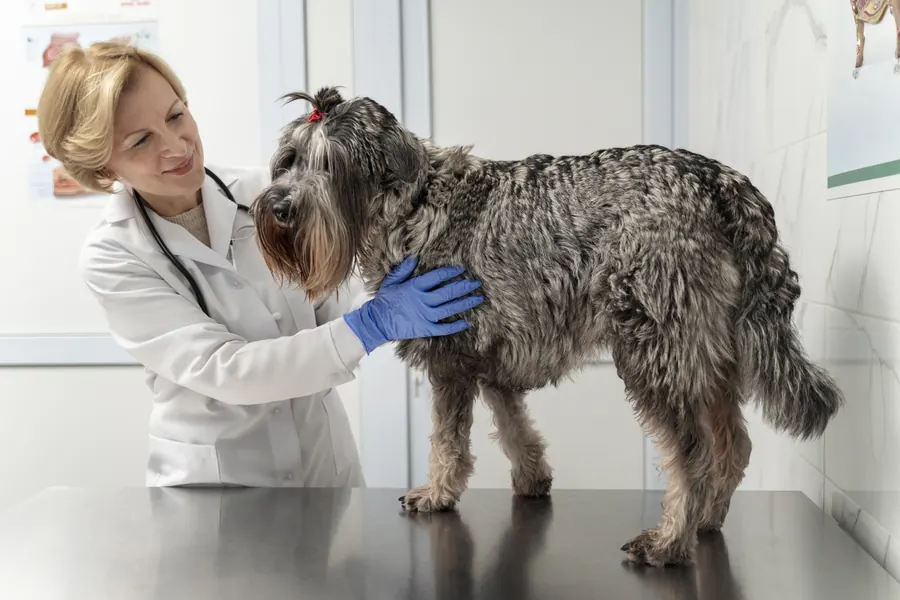
When to see a vet urgently
Gradual weight gain in an otherwise well dog can be assessed at a routine appointment. Unexplained weight changes need further investigation. Seek emergency care for any of the following.
- Difficulty breathing at rest.
- Bluish gums.
- Sudden collapse.
- No response to voice or touch.
Overview
Body fat and condition score
Body fat is assessed using a body condition score, or BCS. The usual canine scale has nine points. Ideal condition is four to five out of nine. At four, ribs are easily felt beneath a thin fat layer. At five, a waist is visible behind the ribs when viewed from above.
Each point above an ideal five out of nine represents an estimated 10% excess weight. Scales show total weight; fat assessment requires separate body condition scoring.
On the nine-point scale, six to seven indicates overweight. Eight to nine usually indicates obesity. At nine, fat accounts for at least around 40% of body weight. Clinical obesity means excess fat causes or worsens an identified health or functional impairment.
Causes
Food intake and energy expenditure
Weight increases when food repeatedly provides more energy than the dog uses. Freely available food can encourage eating beyond requirements. High-fat, low-fibre foods can promote weight gain in otherwise healthy dogs. Table scraps add energy beyond main meals. Food stolen from another pet's bowl also adds to daily intake.
Hypothyroidism can promote weight gain. Cushing's disease can contribute to excess weight. Some medications can influence weight gain.
Equal-sized portions of different foods can contain different amounts of energy. Complementary foods, chews and supplements can increase the daily total.
Risk factors
Energy requirements can fall after neutering. Weight often accumulates in middle age. Low activity increases risk. Labrador Retrievers and Beagles are prone to weight gain.
A POMC gene variant has been linked to greater food motivation in Labrador and Flat-Coated Retrievers. Flat-Coated Retrievers inheriting it from both parents had around 25% lower resting energy expenditure after accounting for body weight.
Reduced middle-age energy requirements can cause weight gain on unchanged portions. Requirements also depend on activity and life stage. Growth and lactation change energy and nutrient needs.
Typical symptoms
Assess fat accumulation by looking from above and the side and feeling the ribs.
- At BCS six, ribs remain palpable beneath a thin excess fat layer.
- At seven, the waist is difficult to distinguish from above.
- At eight, the abdominal outline is flat or rounded from the side.
- At eight, a thick fat layer makes ribs difficult to feel.
- At nine, fat deposits may also be visible on the neck and limbs.
Palpable fat accumulates over the lower back and tail base by BCS seven.
At six, the abdomen may still tuck upwards towards the hind legs despite excess fat over the ribs. Mobility problems may appear as stiffness or reluctance to climb stairs.
Complications and consequences
Joints and breathing
Excess weight loads joints and can worsen osteoarthritis symptoms. Pro-inflammatory substances released by fat tissue can contribute to joint inflammation. Excess weight can increase anaesthetic complication risk by burdening the respiratory system.
Lifespan
A North American study compared lifespan with middle-age body condition in 50,787 neutered pet dogs. Overweight dogs had shorter median lifespans in all 12 breeds examined. Male Yorkshire Terriers had median lifespans of 13.7 years when overweight and 16.2 years at normal weight. Corresponding medians for male German Shepherd Dogs were 12.1 and 12.5 years.
The instantaneous risk of death in overweight German Shepherd Dogs was 1.35 times that of normal-weight dogs of the breed. The corresponding hazard ratio in Yorkshire Terriers was 2.86.
Diagnosis at the vet
Weight, fat and muscle
The vet compares current weight with previous measurements. Body shape and palpation of the ribs help assess fat. Muscle condition is assessed separately because overweight dogs can also lose muscle. This involves feeling around the spine, shoulder blades, skull and pelvis. Loss is often first detected on either side of the spine. It is recorded as mild, moderate or severe.
The feeding history covers meals, treats, scraps, supplements and food used to give medication. Abnormal examination findings guide further investigations.
Additional investigations when needed
BCS seven out of nine or higher warrants closer assessment of fat accumulation's health effects. This may include urine and blood tests for other disease. Fasting triglycerides and cholesterol, for example, can add metabolic information. Mobility assessment considers how much excess fat worsens the problem. Waist circumference can supplement assessment, particularly at BCS eight or higher. Palpation for suspected muscle loss is particularly useful beneath substantial subcutaneous fat.
Treatment
Diet and exercise
The vet sets a target weight and uses it to estimate energy needs during weight loss. Weight-loss food can provide less energy in the same volume. Fibre can promote fullness with less energy. Adequate protein helps preserve muscle during weight loss. Drastically reducing ordinary maintenance food can leave some nutrients insufficient.
Exercise supports muscle and joint function during weight loss. Increase activity gradually in previously inactive dogs to avoid injury. Dogs with joint pain can have an exercise plan developed with a rehabilitation professional.
Changing foods over four to seven days can reduce digestive upset. Vet-selected weight-loss food has greater nutrient density to maintain adequate intake with smaller portions. With two concurrent diseases, diet is selected for both nutritional needs.
A small comparison randomly allocated 13 overweight dogs to dietary weight-loss or exercise groups. Dogs receiving weight-loss food lost a median 10% of starting weight. The exercise group's median loss was 2%, which was not statistically significant.
Monitoring weight loss
One to two per cent of body weight weekly may be a suitable goal in a veterinary programme. Loss exceeding 2% weekly can cause muscle loss. Check weight at least every two weeks during weight loss. Target weight can be refined at follow-up.
An international three-month weight-management study involved 340 veterinary practices in 27 countries. All programme follow-ups were attended by 987 dogs, or 63.1% of those starting. Reliable weight data from every visit were available for 926 dogs.
Weight fell in 896 dogs, or 96.8% of those with complete follow-up data. Mean loss was 11.4% of starting weight. The average rate was 0.9% of starting weight weekly. More than 10% of starting weight was lost by 543 dogs, or 58.6% analysed. Target weight and ideal condition were achieved by 65 dogs, or 7.0% analysed.
Weight loss effects on lameness were monitored for 16 weeks in obese dogs with hip or elbow osteoarthritis. Lameness improved significantly after an average loss of 6.10%. Gait analysis supported the lameness findings after an 8.85% loss.
At a specialist weight-management clinic, 87 dogs reached target weight: 61% of the 143 with known outcomes. Very high starting body fat was associated with a lower chance of reaching target.
Comparing dry and raw diets in one study
A weight-loss study from northern Europe randomly allocated dogs to dry or raw diets for 12 weeks. It also included normal-weight controls. Preliminary findings showed overweight dogs reached healthy weight faster than expected on both diets. Body composition changes differed between diet groups in the preliminary findings.
Prevention
Adapt food quantities to age, size and health to maintain appropriate weight. Complete food should provide at least 90% of daily energy. Treats and other extras should provide no more than 10%. Separate feeding areas in multi-pet homes reduce access to another pet's portion. Regular weighing helps detect weight gain after reaching target. Assess portions by comparing energy from all foods with maintenance requirements. Food found outdoors can add energy without appearing in household feeding quantities.
Refine package feeding guidance by monitoring weight, body fat and muscle condition. Muscle loss can reduce weight in older dogs, so monitor muscle condition too. Offering part of the ration as enrichment allows dogs to spend some feeding time searching for food.
Important for dog owners
Managing the daily ration
Record table scraps and food given with medication in a feeding diary. Weigh portions on kitchen scales for consistent quantities each day. Heaped measures can increase intake unnoticed. Record actual consumption if some food is left. Take training rewards from the daily ration so training does not increase the total. Offering some kibble in a food toy makes the same portion last longer. Play, walks or brushing can replace some food-based attention.
Checking food labels
Check that food is intended for dogs and whether it is labelled complete or complementary. Complete food is intended to meet daily nutritional needs on its own. Complementary food supplements other food, for example with minerals, vitamins or protein. In countries with such labelling requirements, food specifically intended for weight reduction states this purpose on the packaging.
You can use the food calculator for an initial estimate.
Frequently asked questions
Can exercise alone help my dog lose weight?
Weight loss combines exercise with dietary changes so daily energy intake matches the goal. Walking and swimming are examples of relatively low-impact activities. Regular exercise helps maintain muscle as fat decreases.
Why can a muscular dog weigh the same as an overweight dog?
Scale weight includes fat and muscle, so shape and tissue amounts are assessed alongside weighing. An overweight dog can lose muscle while still carrying substantial fat. Muscle changes are often first felt on either side of the spine.
Can my dog still have treats during weight loss?
Yes, if included within daily energy intake and limited to no more than 10%. Small pieces usually allow frequent rewards during training. Some weighed complete food can be used as rewards on walks or during training.
How can I tell if weight loss is too fast?
Weigh your dog at least every two weeks to track the rate. Loss above 2% weekly can reflect insufficient energy or illness. Follow-up also checks muscle condition because rapid loss can include muscle.
How does feeding change after reaching target weight?
A maintenance portion is planned and assessed through weighing and condition scoring. The diet retains complete food meeting nutrient needs. Rewards and extras still count towards daily maintenance energy intake.
Sources
- Emergency and Critical Care: emergent conditions, Cornell University College of Veterinary Medicine, accessed 2026-11-06.
- Obesity and weight loss in dogs, Cornell University College of Veterinary Medicine, accessed 2026-11-06.
- 2021 AAHA Nutrition and Weight Management Guidelines for Dogs and Cats, American Animal Hospital Association, accessed 2026-11-06.
- Koiran hyvinvointimalli, Suomen Kennelliitto, accessed 2026-11-06.
- Body Condition Score – Dog, World Small Animal Veterinary Association, accessed 2026-11-06.
- Muscle Condition Score – Dog, World Small Animal Veterinary Association, accessed 2026-11-06.
- POMC study in Labrador and flatcoated retrievers (2024), University of Cambridge, accessed 2026-11-06.
- Success of a weight loss plan for overweight dogs: international study (2017), PLOS One, accessed 2026-11-06.
- Association between life span and body condition in neutered client-owned dogs (2019), Journal of Veterinary Internal Medicine, accessed 2026-11-06.
- The effect of weight loss on lameness in obese dogs with osteoarthritis (2010), Veterinary Research Communications, accessed 2026-11-06.
- DogRisk in the media – Autumn 2026, Helsingin yliopisto, accessed 2026-11-06.
- Koiran ruokavalion vaikutus ylipainoon, Helsingin yliopisto, accessed 2026-11-06.
- Clinical Obesity in Dogs and Cats: Definition and Diagnosis, World Pet Obesity Association, accessed 2026-11-06.
- Randomised comparison of dietary caloric restriction and physical activity for weight loss in overweight pet dogs (2019), The Veterinary Journal / University of Liverpool Repository, accessed 2026-11-06.
- Low resting metabolic rate and increased hunger due to POMC deletion (2024), Science Advances / University of Hertfordshire Repository, accessed 2026-11-06.
- Cohort Study of the Success of Controlled Weight Loss Programs for Obese Dogs (2015), Journal of Veterinary Internal Medicine, accessed 2026-11-06.
- Dietary caloric restriction versus physical activity in overweight dogs (2019): full text, The Veterinary Journal / University of Liverpool Repository, accessed 2026-11-06.
- Tietoa pakkausmerkinnöistä, Ruokavirasto, accessed 2026-11-06.
This information does not replace a visit to a vet. In an emergency, contact your nearest emergency vet: find a vet (RCVS).
More on this topic: General conditions
- Addison's disease in dogs: symptoms, crisis and treatment
- Hypothermia in dogs: signs, first aid and treatment
- Alcohol poisoning in dogs: symptoms and first aid
- Wasp stings in dogs: symptoms, first aid and treatment
- Anaplasmosis in dogs: symptoms, tests and treatment
- Anaemia in dogs: symptoms, causes and treatment