
Dog diseases · Eyes, ears and mouth
Retained baby teeth in dogs: symptoms and treatment
Retained baby teeth are puppy teeth that remain in the mouth when their permanent replacements erupt. They can direct the permanent tooth into the wrong position. Early removal may give an erupting tooth room to settle into a normal bite.
When to see a vet urgently
Contact a vet the same day if there are signs of pain or tissue damage in the mouth. A lower canine tooth striking the roof of the mouth needs urgent treatment.
- The tip of a lower canine presses into the gum or palate when the mouth closes.
- A tooth is broken and a red spot is visible in its centre.
- A baby tooth has turned grey, which may mean the dental pulp has died.
- A canine striking the palate makes eating difficult for your puppy.
You can find a vet near you for help.
Overview
Dogs usually have 28 baby teeth and 42 permanent teeth. Baby teeth begin to erupt at about 3–5 weeks of age. They are sized for a puppy's small mouth and are therefore smaller than permanent teeth. As the jaws grow, there is room for a larger permanent set.
Teeth usually change between 3–7 months of age. The incisors at the front of the mouth change first. Canines change at about 5–6 months. The upper canine is the tooth most commonly retained. Incisors also sometimes fail to fall out to make way for permanent teeth. In the premolar region, a baby tooth may remain without a visible permanent replacement.
A baby tooth and a permanent tooth should not occupy the same place at the same time. However, not every permanent tooth has a baby-tooth stage: the molars at the back erupt directly as permanent teeth. Most puppies have their full permanent dentition by 6–7 months.
Causes
A baby tooth falls out as its root undergoes resorption, meaning it gradually disappears. Pressure from the crown of the developing permanent tooth helps initiate this process. Once root support has gone, the visible crown of the baby tooth falls out. A baby tooth may remain firmly in place if the permanent tooth erupts in the wrong location.
The permanent tooth germ may be in the wrong place from the start because of inherited factors. An injury during development can also displace it. A baby tooth can additionally remain if no permanent replacement develops at all. In that situation, two teeth are not competing for the same space. An absent permanent tooth is a particularly common explanation for a retained baby premolar.
Baby teeth begin forming before a puppy is born. Permanent tooth crowns begin developing within the jawbone immediately after birth. The crowns have hardened by about 11 weeks. The enamel covering a crown is complete when the tooth erupts. No new enamel forms later in life.
Risk factors
Retained baby teeth are common particularly in small dogs and toy breeds. They occur less often in large dogs. Among short-nosed breeds, Pugs and Boston Terriers, for example, are more susceptible than usual. An abnormal number or arrangement of teeth can make a baby tooth difficult to identify in a short-nosed dog's mouth.
In Havanese, retained baby canines in particular are a fairly common problem. Inherited susceptibility is also related to the timing of tooth replacement. However, the precise inheritance pattern of tooth retention is unknown. Mouth structure and permanent tooth development therefore matter alongside small size.
Susceptibility can also appear as a recurring problem among related dogs.
Typical symptoms
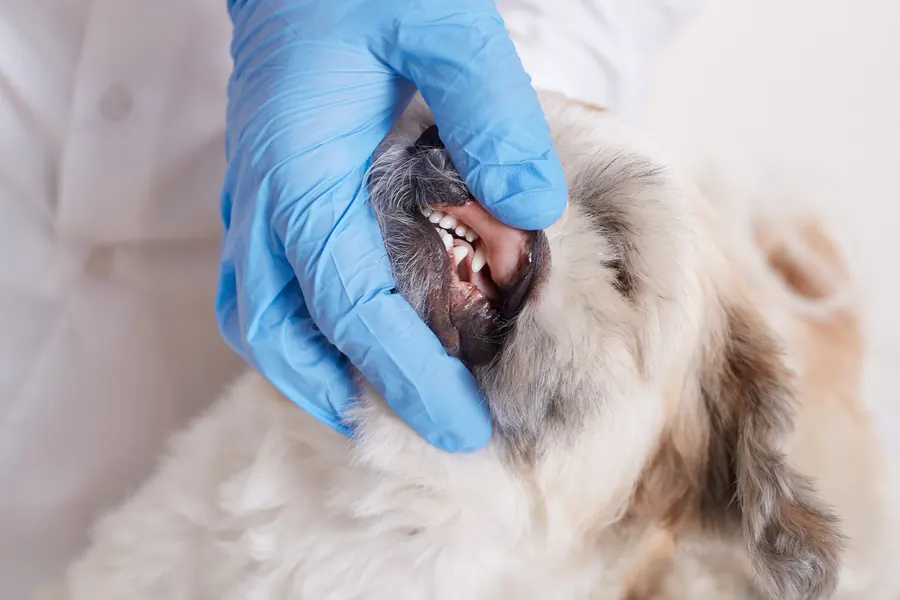
A common finding is two canine teeth immediately beside each other. Looking inside the mouth can reveal the problem before your puppy seems painful. A baby tooth often looks whiter and more delicate than a permanent tooth.
- A baby canine may have a curved shape.
- The space between teeth is narrow, with the teeth almost touching.
- In the upper jaw, the broader permanent canine appears in front of the narrow baby tooth.
- In the lower jaw, the permanent canine emerges on the inside of the baby tooth, towards the tongue.
- Food and plaque can collect in the narrow gap.
- Gums may become inflamed as plaque builds up between the teeth.
Periodontal disease associated with crowding can cause red, swollen or bleeding gums. Your puppy may chew on one side when the mouth is painful. Tartar accumulating on the tooth surface may also become visible to you.
Normal tooth replacement can also involve drooling. A puppy may be less keen to eat when the mouth is tender. The urge to chew is very common during teething. These signs do not establish whether a baby tooth has been retained; the mouth needs to be inspected.
Complications and consequences
Plaque trapped between teeth can lead to periodontitis, inflammation of the tissues supporting a tooth. These tissues include the gums, fibres attaching the tooth and surrounding bone. Advanced periodontal disease can cause premature tooth loss. With an abnormal bite, teeth rubbing against one another can wear down and weaken.
Incorrect tooth contact can interlock the jaws and interfere with their growth. In the worst cases, a permanent lower canine pressing into the palate can create a connection between the mouth and nasal cavity. An abnormal bite can develop within just 2 weeks of a permanent tooth erupting beside a baby tooth. The outlook after extraction is usually excellent.
Exposed pulp in a fractured baby tooth can become inflamed and die. Infection can spread through the root tip to the nearby developing permanent tooth germ. This can cause a malformed permanent tooth crown. An abscess can develop at the root tip of a baby tooth that has died and turned grey.
An upper canine displaced too far forwards can narrow the space where the lower canine tip should sit when the mouth closes. Upper incisors remaining too far back can change a normal scissor bite into a level bite.
Diagnosis at the vet
The vet examines your puppy's mouth and bite from the first check-up onwards. In a malocclusion, the jaws do not meet normally or a tooth erupts at the wrong angle. Examination also assesses any soft tissue damage caused by teeth. An unusually small premolar visible in the mouth may need an X-ray to identify whether it is a baby tooth.
Dental X-rays show the root structure of the baby tooth to be removed. They also locate the permanent tooth developing nearby. If a permanent tooth is not visible in the mouth, imaging establishes whether it is absent or unerupted within the jawbone. A cyst, or fluid-filled cavity, can form around an unerupted tooth and damage the jawbone.
The crown's appearance also helps distinguish normal tooth replacement from dental injury. A grey or pink colour change can indicate disease inside the tooth. The dental pulp contains the tooth's nerves and blood vessels. Pulp inflammation can be identified through dental X-rays and examination under general anaesthesia. Gum and tooth health can also be assessed using instruments to take measurements in the anaesthetised dog's mouth.
Treatment
The vet prescribes treatment and pain relief. A baby tooth is removed when the corresponding permanent tooth starts erupting beside it. Extraction is performed under general anaesthesia. Treatment should not usually be postponed until later castration or spaying. If the permanent tooth has already become established in the wrong position, orthodontic treatment may be needed.
A baby canine's root is long and thin, so it breaks easily during extraction. The vet chooses the extraction technique according to root structure and tooth mobility. An X-ray after extraction confirms that the whole root has been removed. The nearby permanent tooth can be damaged during removal. The root of a newly erupted tooth continues developing for several months.
A healthy baby tooth can sometimes remain if there is no permanent replacement and it does not crowd other teeth. The extraction wound is closed with dissolvable sutures if needed. Soft food is recommended during healing, for about 2 weeks. Hard chew toys and bones are avoided so the sutures do not come apart.
Extraction may be necessary before the normal replacement age if a baby tooth damages the mouth's soft tissues. Removing a baby tooth that strikes the palate eliminates the painful contact it causes. Bite development may still need further treatment as permanent teeth erupt. A fractured baby tooth should be removed as soon as possible.
A root fragment left in the mouth after extraction can interfere with permanent tooth eruption. An infected root fragment may require another removal procedure. A local nerve block can be used for pain relief during extraction. Removing accumulated tartar may also form part of treatment.
In a severe malocclusion, selected additional teeth may need removal to create a pain-free bite. Orthodontic treatment can correct tooth position using special appliances. Assessment by a vet experienced in dentistry may be needed if permanent teeth are already clearly misaligned.
If superficial enamel damage occurs in a permanent tooth during extraction, a filling material can protect it later. Cleaning the mouth after extraction according to veterinary instructions helps prevent infection during healing.
Prevention
Check your puppy's mouth at home weekly until about 7–8 months of age. Bite assessment also forms part of vaccination visits. Gums are sensitive during eruption, so clean gently. Daily brushing is part of regular home dental care. It does not replace extraction of a retained baby tooth crowding a permanent one.
Avoiding hard chews can reduce the risk of tooth fractures. A chew bone is not a safe way to try to dislodge a firmly attached baby tooth. Do not pull the tooth yourself: it may break and leave the root beneath the gum. Because of the inherited background, breeding is not recommended for a dog with retained baby teeth unless an injury is known to be the cause.
Important for dog owners
Photograph the mouth when you notice a new tooth erupting beside a baby tooth. Record the date and where the tooth is located. Tell the vet about any mouth injury too. Photographs can show how tooth position has changed between appointments. Do not force a painful mouth open to take pictures.
At extraction, ask which teeth were removed and whether any baby teeth remain for monitoring. Check the home-care instructions for diet, suture care and the agreed recheck. If a permanent tooth later erupts looking abnormal, mention the previous extraction: damage to a developing tooth can appear as missing enamel.
Frequently asked questions
When should a dog's baby teeth fall out?
Baby teeth are usually replaced by permanent teeth when a puppy is 3–7 months old. However, a baby tooth remaining beside a permanent one should not be left until the end of that age range; it needs removal as the permanent tooth starts erupting.
Can a baby tooth still fall out by itself later?
Sometimes a baby tooth falls out after 6 months of age. If the permanent tooth has fully erupted and the baby tooth remains, spontaneous loss is unlikely. The permanent tooth's position may already need correction.
Why can I never find the baby teeth that have fallen out?
Puppies often swallow baby teeth, which pass into the digestive tract without harm. The number of teeth found on the floor is therefore not a good way to count those remaining. Instead, check the teeth visible in the mouth and ask the veterinary team for help identifying them if needed.
Is every baby tooth remaining in an adult dog's mouth removed?
Not necessarily. If the permanent tooth is absent, a healthy baby tooth can remain in use if it does not crowd other teeth. Before deciding, X-rays check factors including root health and any unerupted permanent tooth.
Why does removing a baby tooth need general anaesthesia?
A retained baby tooth is extracted under general anaesthesia so the root beneath the gum can also be removed completely. The canine root is particularly long and easily broken. The permanent tooth developing beside it must be protected from damage during extraction.
Sources
- Developmental Abnormalities of the Mouth and Dentition in Small Animals, MSD Veterinary Manual, accessed 2026-11-03.
- Dental Development of Dogs, MSD Veterinary Manual, accessed 2026-11-03.
- Dentistry: malocclusions and retained deciduous teeth, University of Sydney, accessed 2026-11-03.
- Retained Baby Teeth in Dogs, CVS Vets, accessed 2026-11-03.
- Havannankoiran terveydestä: maitohampaiden irtoamattomuus, Havannalaiset ry, accessed 2026-11-03.
- Tietopaketti koiran maitohampaista, Keski-Suomen eläinklinikka, accessed 2026-11-03.
- Persistent Deciduous Teeth (Baby Teeth) in Dogs, VCA Animal Hospitals, accessed 2026-11-03.
- Deciduous Canine Tooth Removal in the Dog, Today’s Veterinary Practice, accessed 2026-11-03.
This information does not replace a visit to a vet. In an emergency, contact your nearest emergency vet: find a vet (RCVS).