
Dog diseases · Reproductive system
Transmissible venereal tumour in dogs: TVT and treatment
Transmissible venereal tumour, or TVT/CTVT, is a canine cancer in which living tumour cells pass from one dog to another. Transmission often occurs during mating, but other close contact can transfer cells too. The tumour bleeds easily. It can usually be treated effectively with chemotherapy.
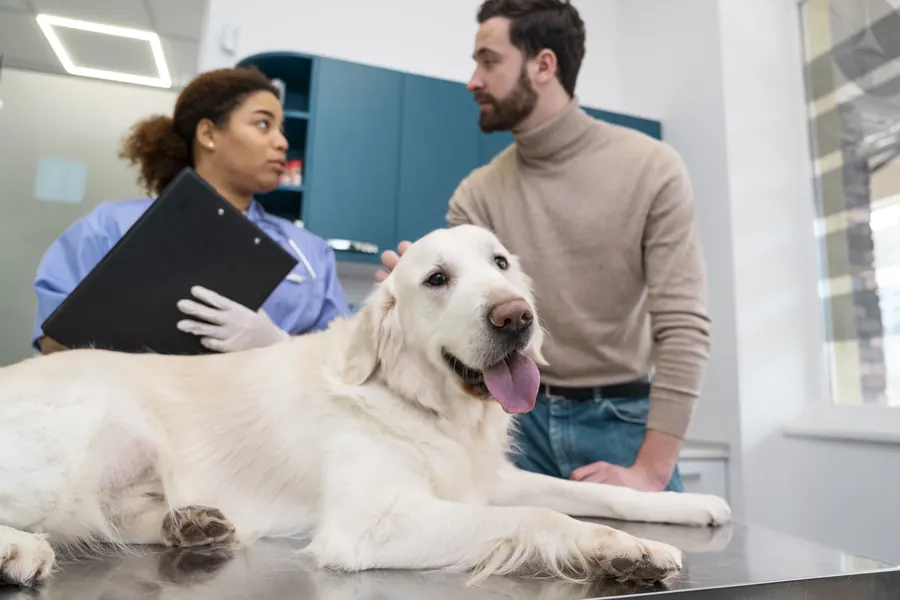
When to see a vet urgently
See a vet promptly if a tumour is accompanied by any of the following:
- Heavy or persistent genital bleeding.
- The penis remains outside the sheath, swells or becomes painful.
- An eye begins to bulge or its position changes noticeably.
- Nosebleeds and facial swelling develop.
- Fever occurs during chemotherapy and blood tests have shown low neutrophil white blood cells.
You can find a vet near you for care.
Overview
The infectious agent in CTVT is the tumour cell itself. These are round cell tumours. CTVT tumours in different dogs belong to the same long-established cell lineage. However, the original cell type is not fully understood.
A lesion may start as a nodule about 5 mm across. A large tumour mass can exceed 10 cm. A dog may have one or several tumour sites.
The disease occurs on every continent except Antarctica. It is uncommon in northern and central Europe. It is more common in tropical and subtropical urban areas.
In a transmission chain at a breeding kennel in northern Europe, TVT was found in 4 dogs. Infection was suspected to have started with a bite from a male imported from Russia. Mating also transmitted the disease within the chain.
Among 131 Brazilian TVT patients, 114, or 87%, had at least genital involvement. Tumours were confined to the genitals in 102 dogs, or 77.9%. They occurred only elsewhere in 17, or 13%. Both genital and other sites were affected in 12, or 9.2%.
Causes
The tumour passes through direct contact with an affected dog's tumour mass. Natural transmission occurs through damaged mucosa. During mating, genital mucosal surfaces are in close contact. Cells can therefore pass from the penis to the vagina or vice versa.
Licking, sniffing, scratching and biting can also transfer tumour cells. Cells may implant in the skin, mouth, nose or conjunctiva of the eye. A mother can transfer cells to a puppy while cleaning it. TVT does not infect people.
An extragenital tumour may arise through direct cell transfer to that site. It may also be a metastasis from an existing tumour. A dog with nasal disease, for example, therefore does not always have a genital tumour.
Risk factors
Free roaming and mating between dogs increase opportunities for transmission. Low neutering rates in a dog population are associated with persistence of the disease. Both males and females can develop genital tumours.
Of the 131 Brazilian CTVT patients, 80, or 61.1%, were female and 51, or 38.9%, male. Among dogs of known age, ages ranged from 6 months to 14 years. Tumours may grow particularly rapidly in newborns or immunocompromised dogs.
Transmission risk also involves international mating contacts and dogs arriving from abroad.
The disease is often found in young dogs that have reached sexual maturity.
Typical symptoms
Tumour location affects what you notice:
- Blood seeps from the vagina or penile area.
- Your dog repeatedly licks the vulva or sheath.
- A visible lesion is nodular or cauliflower-like and bleeds easily on contact.
- Your dog sneezes or has nosebleeds.
- An eye waters or protrudes more than usual.
- Skin nodules appear or facial shape changes.
A tumour deep in the vagina or sheath may be hidden on external inspection. The first sign may be drops of blood on the floor or carpet. Discharge can be mistaken for blood in the urine from another cause.
An oral tumour may also cause bad breath.
Complications and consequences
The tumour surface may ulcerate and become inflamed. Secondary bacterial infections are also common. Genital TVT is associated with increased risk of bacteria in the urine. A deep tumour may prevent the penis returning inside its sheath.
Metastases develop in an estimated 5% of cases. Regional lymph nodes are the most common site. The tumour can also spread to organs such as the eye, brain, kidneys or spleen. Brain and eye metastases are generally associated with a poor outlook.
Diagnosis at the vet
Cell sampling and tumour identification
Diagnosis is usually confirmed by cytology. A sample can be taken with a fine needle or by pressing the tumour surface onto a slide. Large round tumour cells are seen. They typically contain clear, bubble-like vacuoles.
Among the 131 Brazilian dogs, 128, or 97.7%, were diagnosed from a cell sample. A tissue sample was needed in 3, or 2.3%. Every patient diagnosed by tissue sampling had an extragenital tumour.
A tissue sample does not always reliably distinguish CTVT from other round cell tumours. Lymphoid tumours in particular can resemble extragenital TVT. Other alternatives include histiocytoma and plasmacytoma.
PCR and assessing lesions elsewhere
PCR can identify a characteristic tumour DNA change. It may improve diagnostic accuracy. It can also help assess when chemotherapy should end.
CTVT may resemble cutaneous leishmaniasis. Leishmania protozoa may rarely be found inside tumour cells too. An extragenital location can therefore make recognition more difficult.
A cell sample from a regional lymph node can investigate possible metastasis.
Treatment
Chemotherapy and assessing response
Vincristine is the first-choice chemotherapy drug for CTVT. It is given intravenously under veterinary care. A complete response means no visible tumour mass remains at review. Uncertain residual tissue can be checked with another cell sample.
Of 85 Brazilian dogs treated with vincristine, 78 achieved a complete response, or 91.8%. Five, or 5.8%, had a partial response. Disease remained stable in 2, or 2.4%. Combining complete and partial responses, 83 dogs, or 97.6%, responded.
A partial response meant the tumour shrank by more than 30% but remained present. A larger tumour may regress more slowly during treatment. Older age may also slow tumour shrinkage.
Vincristine adverse effects include digestive symptoms. It can also suppress blood cell production in the bone marrow. Leakage outside the vein can cause severe local tissue damage.
Managing adverse effects and monitoring
Chemotherapy can temporarily damage rapidly renewing normal cells too. Bone marrow suppression particularly reduces neutrophil numbers. Follow-up assesses blood counts, temperature and clinical wellbeing. Neutrophil counts are monitored particularly closely when assessing treatment safety.
Chemotherapy-related vomiting may start within 24 hours or be delayed for 1–5 days after treatment. Digestive adverse effects last an average of 3 days. The vet may prescribe anti-sickness medicines. Medicines supporting appetite may also help maintain nutrition when needed.
Vincristine needs particular consideration in a dog with an MDR1 gene variant. Persistent appetite loss may be managed with supportive medication or changes to cancer treatment. Monitoring appetite and weight helps adapt the plan.
After more strongly marrow-suppressive doxorubicin or lomustine treatment, blood counts are often checked about 7 days after administration.
When first-line treatment is insufficient
A tumour responding poorly to vincristine may be treated with doxorubicin, for example. Radiotherapy is another effective option for poorly responsive tumours. Lomustine is another medicine used in resistant cases. Surgical removal may also be necessary.
Surgery is generally a later, third-line option.
Of the Brazilian dogs with partial responses, 3 subsequently underwent surgery. Including those receiving other further treatments, every partial-response patient eventually achieved a complete response. One dog treated with a drug combination had recurrence after 8 months. It achieved another complete response after retreatment.
Surgery also achieved remission in 2 dogs whose disease had remained stable after vincristine.
Tumour location may prevent complete surgical removal. Recurrence is then likely without additional radiotherapy or medication. Spontaneous regression is possible, but CTVT usually progresses and requires treatment. The outlook for a complete response is good if metastases have not affected organs other than the skin.
Reproductive ability after treatment
Chemotherapy may reduce semen quality. Vincristine can be associated with changes in sperm structure. The breeding outlook after TVT is guarded because recurrence is possible.
Prevention
Dogs intended for mating are examined carefully to rule out active TVT. Health assessment also includes previous matings and any genital disease. Close genital inspection may reveal a visible tumour.
Artificial insemination does not completely remove transmission risk associated with semen or its collection. Licking and other close tumour contact can also expose a dog. There is no TVT vaccine.
In large stray dog populations, reproductive control and treatment of affected dogs reduce disease occurrence.
Important for dog owners
Tell the vet your dog's country of origin, previous homes and travel abroad. Mention mating, fights and other close contact with dogs that had tumours or bloody discharge. Record when bleeding began, where it seems to come from and any lumps elsewhere. Bring previous cytology and tissue sample results.
Agree with the vet on restricting dog contact and mating during investigation and treatment. Ask how tumour clearance will be confirmed and which symptoms require a prompt return. During medication, record appetite, vomiting, diarrhoea, urination and general wellbeing. If future breeding is planned, discuss transmission risk assessment and semen testing.
Frequently asked questions
Can this canine cancer infect people?
TVT does not infect people. The infectious agents are living tumour cells transferred between dogs. Transmission may occur during mating or other direct close contact with a tumour. Cells can also pass from mother to puppy during care.
Can a dog acquire it without mating?
Sniffing, licking, scratching or biting can transfer tumour cells through direct contact. A mother may infect a puppy while cleaning it. Tumours can also develop in the nose, mouth or skin. There may then be no genital tumour at all.
Can my dog have TVT without a visible genital tumour?
A tumour may lie deep in the vagina or sheath and be missed during a quick inspection. The first sign may be blood on the floor alone. TVT can also occur entirely outside the genitals. This can make recognition more difficult.
Is removing the tumour enough?
Complete removal is not always possible because of its anatomical location. Remaining tumour cells carry a recurrence risk. Vincristine is usually the first-choice treatment. Surgery or another treatment may be considered for chemotherapy-resistant disease. Radiotherapy can also work against a drug-resistant tumour.
Can TVT disappear by itself?
Spontaneous regression is possible. However, the tumour usually progresses and is treated accordingly. Chemotherapy or radiotherapy generally offers a good outlook for complete response unless disease has spread beyond the skin to other organs. Eye or central nervous system metastases worsen the outlook.
Sources
- Canine Transmissible Venereal Tumor, Merck Veterinary Manual, accessed 2026-11-05.
- Overførbar venerisk tumor hos hund, Veterinærinstituttet, accessed 2026-11-05.
- Canine Transmissible Venereal Tumor: Anatomical Locations, Chemotherapy Response, and Epidemiological Aspects at a Veterinary Teaching Hospital in Brazil (2012–2022), Animals 2025 / City University of Hong Kong, accessed 2026-11-05.
- Koiran tarttuva sukuelinkasvain (TVT, Stickerin sarkooma) – kirjallisuuskatsaus ja tapausselostus, Suomen Eläinlääkärilehti 2010, accessed 2026-11-05.
- Paraphimosis in Dogs and Cats, Merck Veterinary Manual, accessed 2026-11-05.
- 2026 AAHA Oncology Guidelines: Therapeutic Modalities – Chemotherapy, American Animal Hospital Association, accessed 2026-11-05.
- Clinical Guidelines for Canine Transmissible Venereal Tumour Treatment: Systematic Review and Meta-Analysis, Veterinary and Comparative Oncology 2025, accessed 2026-11-05.
This information does not replace a visit to a vet. In an emergency, contact your nearest emergency vet: find a vet (RCVS).
More on this topic: Reproductive system
- Vaginitis in dogs: discharge, symptoms and treatment
- Vaginal hyperplasia in dogs: swelling and treatment
- Balanoposthitis in dogs – discharge and inflammation
- Enlarged prostate in dogs – symptoms and treatment
- Prostatitis in dogs: prostate infection and treatment
- Infertility in dogs – causes, investigations and treatment