Contents
- What happened
- Why the hornet is a problem
- Why ordinary traps do not help
- The "Trojan horse" idea
- A camera that recognises the hornet
- A tag with fungal spores
- The way into the nest
- Not only hornets
- The iGEM competition
- What still needs testing
- Is the fungus safe?
- How the Asian hornet reached Europe
- How to tell the Asian hornet apart
- Is the hornet dangerous to people?
- The danger to dogs and cats
- If your pet is stung by a hornet
- How to report a nest
- Protecting hives
- Bees and people
- Students and science
- Technology and biodiversity
- How a hornet colony lives
- Why timing matters
- Spring traps
- What this means for Europe
- When to see a vet
What happened
On 9 November 2026, the Vrije Universiteit Brussel (VUB) announced that a team of its students had developed a new way to fight the Asian hornet. The authors call it a "Trojan horse": the hornet unwittingly carries into its own nest an agent that can destroy the whole colony. The Brussels news outlet BRUZZ reported the story.
Why the hornet is a problem
The Asian hornet is an invasive species that has spread to many Western European countries in recent years. It hunts honeybees, lying in wait for them at the hive entrance. Bee colonies weaken, stop flying out for nectar and may die. The hornet also threatens other insects and therefore biodiversity as a whole.
Why ordinary traps do not help
Fighting the Asian hornet is hard. Ordinary traps only catch individual workers, while the queen in the nest keeps laying eggs and the colony quickly makes up its losses. Chemicals can destroy a nest, but they also harm beneficial insects and other organisms. Nests are also often high up in tree crowns.
The "Trojan horse" idea
So the students proposed a biological method that works from inside the colony. The project combines artificial intelligence, a mechanical trap and biological nanofibres. The aim is not to kill hornets one at a time but to use a captured individual as a courier that delivers a biological agent into the nest.
BRUZZ, based on VUB; 9 November 2026
A camera that recognises the hornet
First, an AI camera comes into play. It recognises the Asian hornet with a stated accuracy of more than 99%. That matters because other insects can fly into the trap too, such as honeybees or native wasps. The system lets them go and acts only against the target species.
A tag with fungal spores
When an Asian hornet enters the trap, a small biological tag is applied to it. It contains spores of the soil fungus Beauveria bassiana. This fungus has long been used as a biological control agent against insect pests. The spores germinate on the insect's body, penetrate inside and kill it.
The way into the nest
After tagging, the hornet is released. It returns to its nest and comes into contact with other hornets, larvae and the queen. The fungus spreads inside the colony. In this way the whole nest can be destroyed without even knowing where it is. For the Asian hornet, whose nests are hard to find, this is especially important.
Not only hornets
According to the authors, the system could be used against more than the Asian hornet. In future it could be adapted to fight other invasive insects. The key is to train the camera to recognise the target species and to choose a biological agent that is safe for the environment.
The iGEM competition
The students will present their research at the international iGEM competition, held in Paris from 13 to 16 November. It is the largest competition for student teams in synthetic biology. Teams from around the world present projects that tackle real problems, from medicine to nature conservation.
What still needs testing
For now the method is still a student project. Before it can be used in practice, it must be tested how reliably the fungus spreads in real nests, how quickly the colony dies, whether the fungus reaches other insects and how the system works in different weather. Such trials usually take several seasons.
Is the fungus safe?
Beauveria bassiana is widespread in soils around the world and is already used in agriculture as a biological insecticide. It infects insects but is considered safe for people, dogs and cats. The advantage of the method is that the fungus is delivered precisely, straight into the hornet's nest, rather than sprayed across the surrounding area.
How the Asian hornet reached Europe
According to the most common account, the Asian hornet was accidentally brought to France in the early 2000s with a cargo from Asia. Since then it has spread across France, Spain, Portugal, Italy, Belgium, the Netherlands, Germany and the UK. The hornet has adapted well to the European climate and is quickly colonising new areas.
How to tell the Asian hornet apart
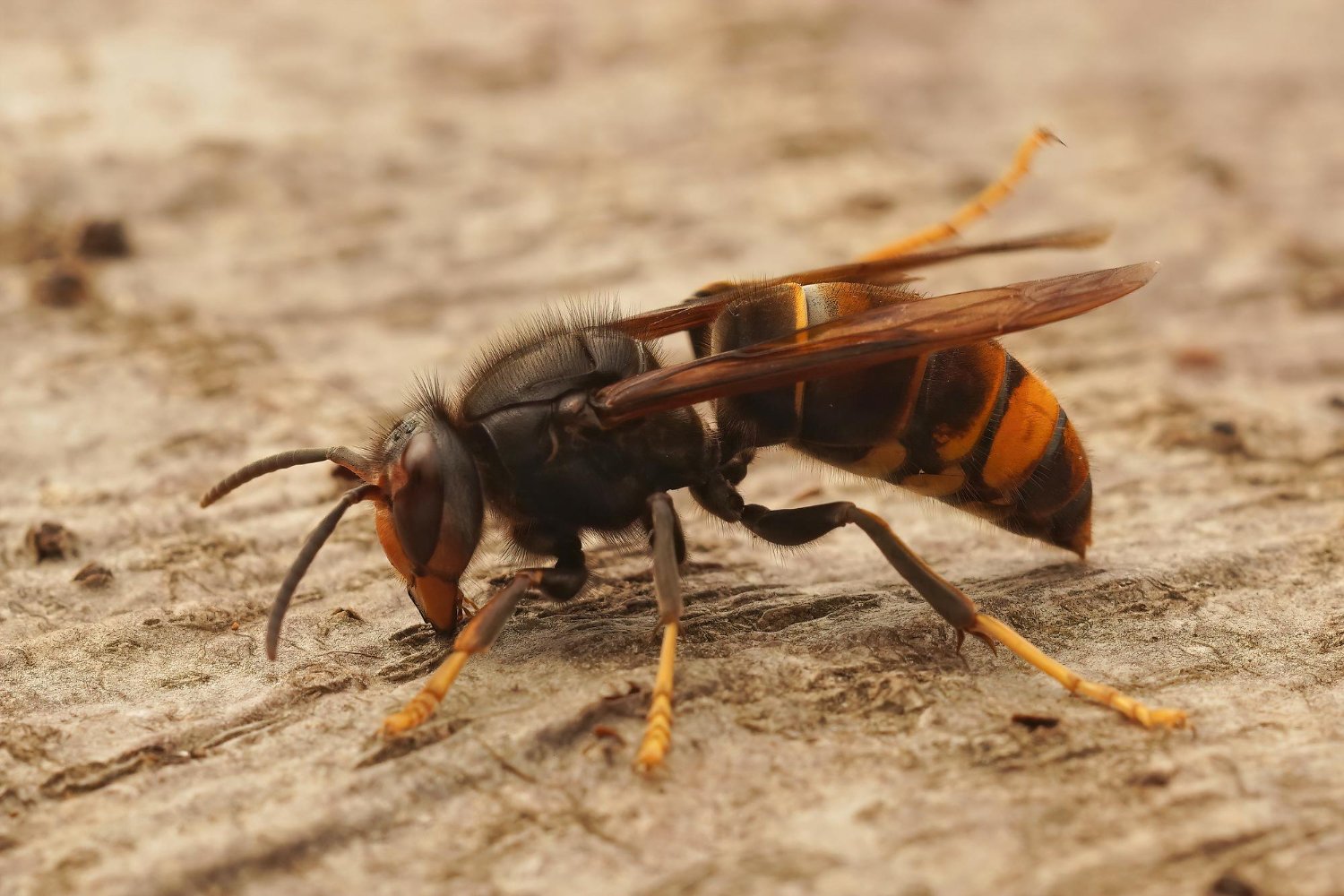
The Asian hornet is smaller and darker than the European hornet. It has an almost black body with a single orange band on the abdomen and yellow-tipped legs. The European hornet is larger, with a reddish-brown head and a yellow and black abdomen. The native hornet does not need to be destroyed: it is beneficial and attacks bees less often.
Is the hornet dangerous to people?
The Asian hornet does not usually attack people away from the nest. But if you get too close to a nest, hornets can attack as a group. Their stings are painful and dangerous for people with allergies. That is why nests must not be tackled yourself: they are removed by specialists in protective suits.
The danger to dogs and cats
Dogs and cats are curious and may disturb a nest in bushes, a hedge or near the ground. Dogs that like to snap at flying insects are especially at risk. A sting to the face or mouth can cause severe swelling, and multiple stings can be life-threatening. Small animals are affected more severely.
If your pet is stung by a hornet
What to do if a dog or cat is stung by a hornet:
- Lead the animal well away from the nest.
- Check the sting site and apply something cold.
- Watch its breathing and any swelling of the face and neck.
- If there is swelling in the mouth or throat, go to the vet immediately.
- If there are many stings, see a vet in any case.
How to report a nest
Many countries have services for reporting Asian hornet nests. In Belgium and the Netherlands, nature observation websites and regional services are used. In the UK, sightings can be reported through the Asian Hornet Watch app. It is important to photograph the hornet or nest but not to go close. Specialists will assess the situation and arrange for the nest to be destroyed.
Protecting hives
Beekeepers protect hives from hornets by narrowing the entrances and using mesh and special traps at the apiary. But these measures only reduce the damage and do not solve the problem as long as there are hornet nests nearby. That is why beekeepers are especially interested in methods that destroy whole colonies.
Bees and people
Honeybees pollinate many crops: fruit, berries, vegetables and oilseed rape. Their decline hits beekeepers, farmers and nature alike. The Asian hornet is only one of the threats, alongside the varroa mite, pesticides and the loss of flowering plants. Any new way of protecting bees benefits the whole ecosystem.
Students and science
The VUB project is an example of student teams proposing solutions to real problems. A multidisciplinary team of biologists, engineers and data specialists makes it possible to combine different technologies. Even if the method does not go into practice straight away, such projects give professional researchers new ideas.
Technology and biodiversity
Artificial intelligence is increasingly helping to protect nature: it recognises animals in camera traps, birds by their songs and insects in traps. A camera that tells an Asian hornet from a bee is an example of this approach. It allows precise action without harming beneficial species.
How a hornet colony lives
In spring, an Asian hornet queen that has overwintered in shelter builds a small primary nest. In summer the colony moves to a large nest, often high in a tree, where thousands of workers live. In autumn new queens and males hatch in the nest. If the nest is destroyed before then, there will be fewer new colonies in the area the following spring.
Why timing matters
That is why methods that destroy nests in summer and early autumn are especially valuable. Every nest that manages to raise new queens can give rise to dozens of colonies the next year. In late autumn, when the young queens have already left, destroying the old nest has almost no effect on hornet numbers.
Spring traps
Some specialists advise setting traps in spring to catch overwintered queens before they build nests. But such traps often catch native insects too, including beneficial ones. That is why more attention is being paid to selective methods that recognise the Asian hornet specifically, as in the VUB students' project.
What this means for Europe
The Asian hornet has already become a problem for many European countries, and the EU has put it on its list of invasive species that must be controlled. If the Brussels "Trojan horse" proves effective in field trials, it could become a new tool for beekeepers and invasive species services across Europe.
When to see a vet
Take a dog or cat to the vet urgently if, after a hornet or wasp sting, its face, lips or throat swell, it has difficulty breathing, vomits, becomes weak, has pale gums or collapses. With multiple stings, help is needed even without obvious symptoms: a reaction can develop several hours later.
Sources
- BRUZZ, 9 November 2026