
Veterinary care in the UK · Law and rules
Dog laws in the UK: what every owner needs to know
Owning a dog in the UK comes with legal responsibilities as well as daily care. Some rules are well known, such as microchipping; others, like the requirement for an ID tag on the collar, surprise many owners. Breaking them can lead to fines, criminal records and, in the most serious cases, prison or the loss of a dog. This guide summarises the main laws that apply to everyday dog ownership in England and Wales, with notes on where the rules differ. It is a general guide, not legal advice.

Every dog in a public place must wear a collar with the owner's name and address.
Collar and ID tag
Under the Control of Dogs Order 1992, every dog in a public place, such as a street or a park, must wear a collar with the name and address of the owner inscribed on the collar or on a plate or badge attached to it. Not following this rule is an offence, and a dog without the required collar may be seized and treated as a stray.
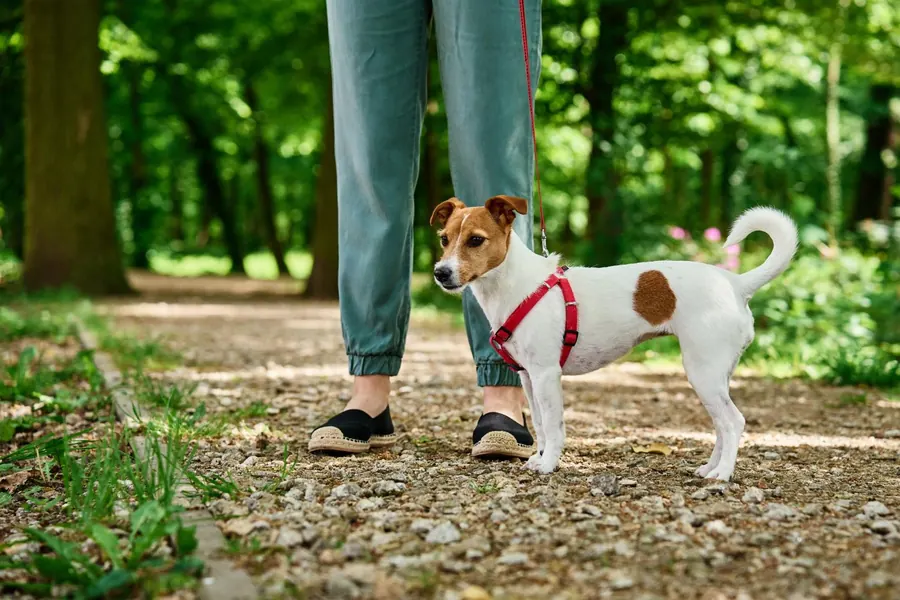
There are some exemptions, for example for certain working dogs while working and for some assistance dogs. Many owners also add a phone number. You do not have to put your dog's name on the tag, and some owners prefer not to.
Microchipping
In England, all dogs must be microchipped and registered on a compliant database by the time they are 8 weeks old, and keepers must keep their contact details up to date. Cats in England must be microchipped by 20 weeks old. If you move house or change your phone number, update the database. See our guide to microchipping law.
A microchip does not replace the collar and tag: both are required.
Keeping your dog under control
It is against the law to let any dog be dangerously out of control anywhere: in a public place, in a private place such as a neighbour's garden, or in the owner's own home. The law applies to all dogs, whatever their breed or size.
According to GOV.UK, a dog is considered dangerously out of control if it injures someone or makes someone worried that it might injure them. A court could also decide a dog is dangerously out of control if it attacks someone's animal, or if the owner of an animal thinks they could be injured trying to stop the attack.
The penalties are serious:
- an unlimited fine or up to 6 months in prison, or both, if your dog is dangerously out of control;
- up to 5 years in prison or a fine, or both, if you let your dog injure someone;
- up to 14 years in prison or an unlimited fine, or both, if you allow your dog to kill someone;
- up to 3 years in prison or a fine, or both, if you allow your dog to injure an assistance dog.
You may also be banned from owning a dog, and the dog may be destroyed.
Banned breeds and XL Bullies
Some types of dog are banned in the UK, and XL Bully dogs are now banned in England and Wales unless they have an exemption certificate. Owners of exempt dogs must follow strict conditions, including keeping the dog on a lead and muzzled in public. See our guide to the Dangerous Dogs Act and XL Bully rules.
Livestock worrying
Dogs chasing or attacking farm animals cause great suffering and financial loss. In December 2025, a new law, the Dogs (Protection of Livestock) (Amendment) Act 2025, strengthened protection for farm animals in England and Wales. The maximum penalty for livestock worrying, when a dog you own or are in charge of attacks or chases livestock on agricultural land, increased from £1,000 to an unlimited fine. Police have been given powers to detain dogs believed to pose an ongoing threat to livestock and to enter premises to secure evidence, and courts can require offenders to cover the costs of seizing and caring for a detained dog.

The Countryside Code advises keeping dogs under control and in sight. In practice, keep your dog on a lead near livestock, and never let it chase sheep, cattle or other animals.
Dog fouling
Councils can take action against owners who do not clean up after their dogs. You can report a dog fouling problem to your local council through GOV.UK. Many councils have local rules, such as Public Spaces Protection Orders, which can require owners to pick up after their dogs, keep them on leads in certain places or keep them out of areas such as children's play areas. Breaking these rules can lead to a fixed penalty notice.
The Countryside Code's advice is simple: bag it and bin it in any public waste bin, or take it home.
Dogs in cars
The Highway Code (rule 57) says that when you are in a vehicle, dogs and other animals should be suitably restrained so they cannot distract you while you are driving or injure you, or themselves, if you stop quickly. A seat belt harness, pet carrier, dog cage or dog guard are ways of restraining animals. An unrestrained dog could also affect your car insurance if there is an accident.
Never leave a dog alone in a hot car. Dogs can suffer heatstroke quickly, even on days that do not feel very hot.
Your duty of care
The Animal Welfare Act 2006 (England and Wales), and equivalent laws in Scotland and Northern Ireland, require anyone responsible for an animal to meet its welfare needs: a suitable environment and diet, the ability to behave normally, appropriate company and protection from pain, suffering, injury and disease. Causing unnecessary suffering is a criminal offence.
Stray and lost dogs
Local authorities in England and Wales have a statutory duty to deal with stray dogs, including lost, stolen or abandoned dogs. Collected dogs are scanned for a microchip and checked for a collar tag. If your dog goes missing, contact your council's dog warden service and check whether the council has your dog. A correctly tagged and microchipped dog is much more likely to be returned quickly.
Scotland, Northern Ireland and Ireland
Most principles are similar across the UK, but details differ. Scotland has its own dog control laws, and Northern Ireland requires dogs to be licensed. In the Republic of Ireland, dogs must be licensed and microchipped, and certain breeds must be muzzled and on a short lead in public. Check local rules if you live outside England and Wales.
Frequently asked questions
Does my dog need a tag if it is microchipped?
Yes. The Control of Dogs Order 1992 requires a collar with the owner's name and address in public places, as well as the microchip.
Can I be prosecuted if my dog bites someone in my home?
Yes. The law on dangerously out of control dogs applies in private places, including the owner's home.
What is the fine for livestock worrying now?
Since the Dogs (Protection of Livestock) (Amendment) Act 2025, the maximum penalty in England and Wales is an unlimited fine.
Do I have to restrain my dog in the car?
The Highway Code says dogs should be suitably restrained so they cannot distract you or be injured if you stop quickly.
Who deals with stray dogs?
Local authorities have a statutory duty to deal with stray dogs found in their area.
Sources
- Controlling your dog in public, GOV.UK, accessed 2026-11-15.
- The Control of Dogs Order 1992, legislation.gov.uk, accessed 2026-11-15.
- Unlimited fines for dog attacks on farm animals, Department for Environment, Food & Rural Affairs, accessed 2026-11-15.
- The Countryside Code: advice for countryside visitors, Natural England, accessed 2026-11-15.
- The Highway Code: rules about animals (47 to 58), GOV.UK, accessed 2026-11-15.
- Report a dog fouling problem, GOV.UK, accessed 2026-11-15.
- Stray and abandoned dogs: local authority responsibilities, Department for Environment, Food & Rural Affairs, accessed 2026-11-15.
 Law and rulesFireworks and pets in the UK: the rules, the season and how to keep your pet calmUK firework rules and curfews, when fireworks season happens, how to prepare dogs, cats and small pets, building a den and when to ask your vet for help.
 Law and rulesPet theft in the UK: how to protect your pet and what to do if it is stolenHow to protect your dog or cat from theft, what the Pet Abduction Act 2024 changed, why microchips and ID tags matter and what to do if your pet is stolen.
 Law and rulesRenting with pets in England: your rights under the Renters' Rights Act and how to make a requestHow the Renters' Rights Act changes renting with pets in England from May 2026: asking to keep a pet, valid reasons to refuse and practical tips.