
Veterinary care in the UK · Law and rules
Microchipping dogs and cats in the UK: what the law requires
A microchip is a small electronic transponder, about the size of a grain of rice, placed under the skin between a pet's shoulder blades. It carries a unique number. When a vet, a dog warden or a rescue centre scans the chip, that number leads to the owner's contact details on a microchip database. It is the most reliable way of reuniting lost pets with their owners, and it is also a legal requirement for all dogs in the UK and for cats in England. This guide explains what the law says, how registration works and what owners need to do throughout their pet's life.
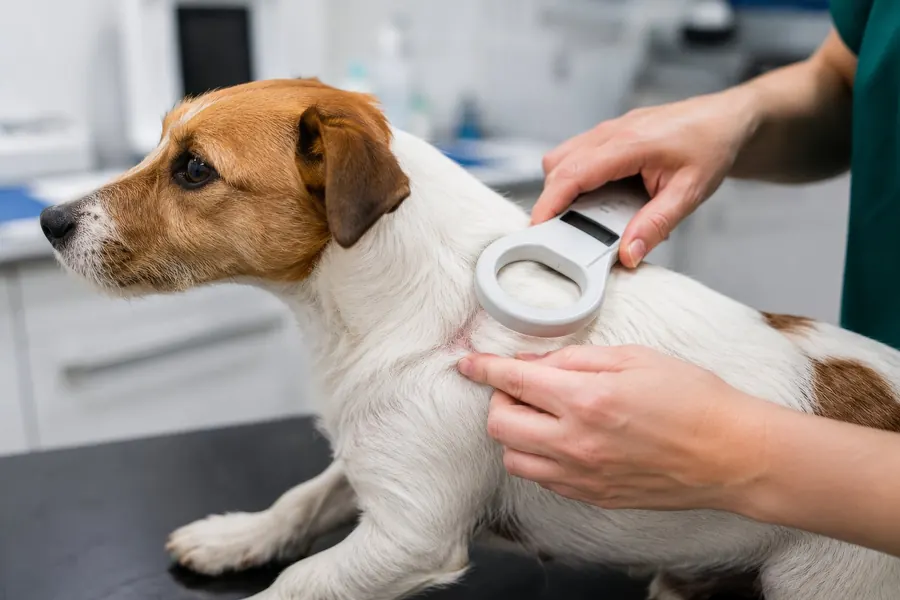
All dogs in the UK must be microchipped and registered by eight weeks of age.
Dogs: compulsory across the UK
All dogs in the UK must be microchipped and registered on an approved database by the time they are 8 weeks old. This means breeders must have puppies chipped before they go to their new homes, and the breeder will usually be recorded as the first keeper.

Dogs must also wear a collar and tag with the owner's name and address in a public place. A microchip does not replace the tag: anyone can read a tag, but a chip needs a scanner.
In Northern Ireland, dogs must also be licensed by the local council. Check the Department of Agriculture, Environment and Rural Affairs (DAERA) and your council for the local rules.
Cats: compulsory in England
In England, cats must be microchipped and registered by the time they are 20 weeks old. This includes cats that usually stay indoors.
In Scotland, Wales and Northern Ireland, microchipping cats is optional but strongly recommended. Cats wander, get shut in garages and sheds and are sometimes taken in by well-meaning neighbours. A chip gives a lost cat a much better chance of getting home.
Fines
You can be fined up to £500 if your dog or, in England, your cat is not microchipped when it should be, or if it is not registered on one of the approved databases. In practice, owners are usually first given a notice to put things right.
Who can microchip your pet
The microchip must be fitted by a trained professional. You can ask your vet, your local council or a rescue and rehoming centre. Some charge a fee, and some charities offer free or low-cost microchipping events.
The procedure takes a few seconds. The chip is injected under the skin with a needle slightly larger than a vaccine needle. Most pets react as they would to an injection, and no anaesthetic is needed. Some owners choose to have it done while their pet is anaesthetised for neutering.
Approved databases
It is not enough for your pet to have a chip. The chip must be registered on a database that meets government standards, with your current address and contact details. At the time of writing, the government lists 25 approved databases, including Petlog, Animal Tracker, Pet Identity UK, UK PETtrac, Identi, MyPet and others.
Be careful with unexpected emails or messages asking you to pay to register or update your pet's details. They may come from scam websites. The government advises reporting suspicious messages to the National Cyber Security Centre. If you are not sure which database your pet's chip is on, you can check the chip number with a free online lookup service and contact the database directly.
One database, Track Your Paws, has been removed from the government list because it does not meet the standards. If your pet is registered there, register it with an approved database instead.
Keeping your details up to date
You are legally responsible for keeping your pet's microchip details current. Update the database when you:
- move house;
- change your phone number or email address;
- rehome your pet or take on a pet from someone else.
Some databases charge a small fee for changes or offer paid premium accounts; others are free. The basic legal requirement is simply that the record is correct.
Rescue centres regularly find chips in stray animals only to discover that the phone number no longer works or the address is years out of date. Checking your details once a year, for example at your pet's annual health check, avoids this.
What to check when you get a dog or cat
Before you buy or adopt a pet, ask for proof that it has been microchipped. Acceptable proof includes:
- a microchip certificate;
- veterinary records;
- a pet passport, for animals that have travelled.
Make sure the registration is transferred into your name after you take the animal home. A puppy must already be chipped and registered by 8 weeks of age. A kitten may not yet be chipped, but in England it must be by 20 weeks.
Microchips and travel
If you plan to travel abroad, your pet must be microchipped before or at the same time as its rabies vaccination. If the chip is fitted after the vaccination, the vaccination has to be repeated. See our guide to travelling abroad with your pet after Brexit.
What happens when a lost pet is found
When a stray dog or cat is handed in to a vet practice, a rescue centre or the council's dog warden service, the first thing staff do is scan it for a chip. If they find one, they look up the number to see which database holds the record and contact that database. The database then contacts the registered keeper, or gives the finder the information needed to return the animal, depending on its procedures.
This only works if the record is complete and current. A chip registered to the breeder, a previous owner or an old phone number can leave a pet in kennels for days while staff try to trace its family. Stray dogs that cannot be returned may eventually be rehomed.
Microchip cat flaps
Microchip-operated cat flaps read your cat's existing chip and only let your own cats in. They are especially useful if neighbourhood cats come into your home and cause stress or steal food.
Frequently asked questions
Does a microchip track my pet's location?
No. A standard microchip has no battery or GPS. It only works when someone scans it. If you want real-time tracking, you need a separate GPS device on the collar.
My indoor cat never goes out. Does it still need a chip?
In England, yes: the law applies to all cats, including indoor cats. Indoor cats do escape through open doors and windows, and they are often more frightened outside than cats used to going out.
Can a microchip stop working or move?
Very occasionally, a chip moves under the skin or fails. Ask your vet to scan it at each annual check. If it cannot be read, a new chip can be fitted and registered.
What should I do if I find a lost dog or cat?
Take it to a vet or rescue centre to be scanned, usually free of charge. For dogs, contact the local council's dog warden service. Do not keep a found animal without trying to trace its owner.
Who do I contact if my pet goes missing?
Report it to your microchip database and mark your pet as lost, then contact local vets, rescue centres and the council dog warden. Give them your pet's chip number and a recent photo.
Sources
- Get your dog or cat microchipped, GOV.UK, accessed 2026-11-14.
- Taking your pet dog, cat or ferret abroad, GOV.UK, accessed 2026-11-14.
- Buying a cat or dog, Department for Environment, Food & Rural Affairs, accessed 2026-11-14.
- 3. 24-hour emergency first aid and pain relief, Royal College of Veterinary Surgeons, accessed 2026-11-14.
 TravelTravelling abroad with your dog, cat or ferret after Brexit: the rules in 2026Pet travel from Great Britain to the EU in 2026: microchip, rabies vaccine, animal health certificate, tapeworm treatment and pet passports.
 Law and rulesDangerous dogs law in the UK: what every owner needs to know, including the XL Bully rulesThe UK law on dangerous dogs for every owner: dogs out of control, penalties, the five banned types, XL Bully exemption rules and the 2026 changes.
 Emergency careOut-of-hours emergency vets in the UK: how night and weekend care worksWho provides emergency vet care at night and at weekends in the UK, what the RCVS requires, what owners must do, how to prepare and what emergency care costs.