When to see a vet urgently
Contact a practice immediately if your pet has, for example:
- difficulty breathing, collapse or altered consciousness;
- seizures or severe weakness;
- severe abdominal pain, bloody vomit or rapidly worsening condition;
- suspected ingestion of toxic food or injury from a swallowed bone.
Do not wait to see whether changing food helps. You can find a vet near you for care.
Start with complete food
- Look for “complete” and “for adults” on the package. It contains all required nutrients in the right proportions.
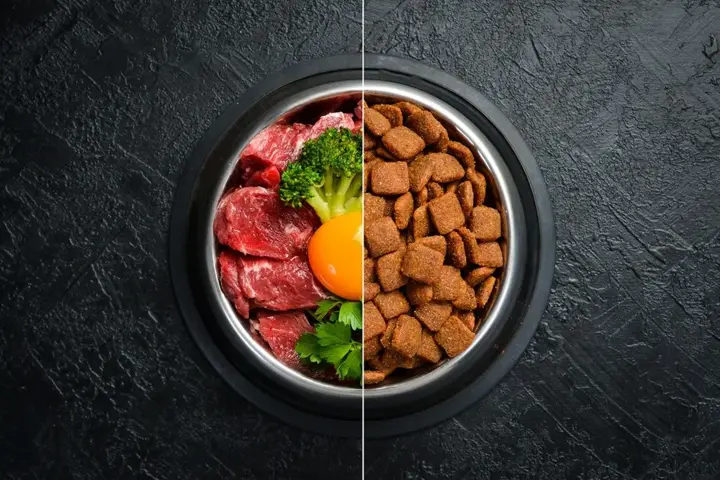
- Dry, wet or mixed feeding are equally suitable when the food is complete. Wet food helps cats obtain more fluid.
- Vitamins or minerals are unnecessary alongside complete food and can disrupt the balance.
Suitability of dry, wet and mixed feeding concerns a whole diet meeting the animal's needs. Illness may require a different food or texture. Distinguish complete from complementary wet food too: not every meaty-looking product suits use as the sole main food.
Check the species, life stage and intended use. The first ingredient alone cannot establish nutrient digestibility or nutritional quality. Ask the manufacturer what nutritional expertise informs formulation and how product content is controlled.
Advice to avoid supplements concerns a healthy animal eating suitable complete food. Your vet may prescribe a targeted supplement for diagnosed illness or deficiency. Mention every product used so that the same nutrient does not accumulate unnoticed from several sources.
How much?
- Package guidance is only a starting point. Adjust it according to body condition, scored on a 1–9 scale with 4–5 ideal: ribs are easily felt beneath a thin fat layer, a waist is visible from above and the abdomen tucks up from the side.
- Weigh your pet monthly.
- Energy needs fall after neutering: reduce portions to prevent weight gain.
- Measure food using a measuring container or scales, rather than by eye.
Animals of the same weight may need different energy intakes if activity, surroundings or health differ. Measure actual intake and monitor changes rather than treating package guidance as a fixed target. Changes after neutering are also assessed individually, with amounts reviewed according to weight and body condition.
Body condition mainly describes fat stores. Muscle assessment complements it because muscle can be lost while excess fat remains. Unplanned weight loss should not be interpreted as successful weight management, particularly with changed appetite, drinking or function.
When switching products or combining wet and dry food, consider both energy contents. Do not give a full daily allowance of each. Treats also count within the daily energy plan; adding them to the usual portion is not always insignificant. Monitoring frequency for an ill animal is agreed separately. Keep previous weights so gradual changes can be identified at the practice.
Feeding routine
- Dogs usually suit twice-daily feeding.
- Cats suit several small portions daily; activity feeders and feeding toys are useful.
- Keep fresh water available at all times.
Divide daily food in a way suited to your animal. Food placed in a toy or automatic feeder is part of the daily allowance, rather than extra. Monitor actual eating: filling a device does not establish adequate intake. Investigate repeatedly untouched food.
In a multi-pet home, ensure everyone can calmly access their own food and water. An emptied shared bowl does not reveal how food was divided. A cat eating wet food also obtains water from it and may drink less from a bowl. Fresh water must still remain available, and a marked new drinking change should not automatically be attributed to food type.
Treats and table food
Treats should provide no more than 10% of daily energy. Never give grapes or raisins, onion or garlic, chocolate, xylitol-containing products, cooked bones, alcohol, caffeine, macadamia nuts or fatty food, which carries a pancreatitis risk.
These hazards vary by species and product. Effects described with grapes and macadamia nuts particularly concern dogs, for example, whereas alliums can also damage a cat's red blood cells. Bones usually cause injury or obstruction, and raw bones can also harm. Report possible exposure with the product and amount eaten.
Fatty leftovers and essential dietary fatty acids are different things. Dogs and cats need fatty acids, so do not remove all fat from a balanced diet as a precaution. The cause of pancreatitis is often unclear; dietary indiscretion is a risk factor particularly in dogs. A cat's illness should not automatically be attributed to one fatty meal.
Home-prepared food
This is possible only with a recipe calculated for the particular animal by a vet experienced in nutrition. Meat, grain and vegetables without a mineral mix lead to deficiencies of calcium, causing fragile bones and fractures, zinc, iodine and vitamins. Cats also need taurine, arachidonic acid and preformed vitamin A; without supplements, homemade food is dangerous for them.
Safety does not depend only on fresh ingredients or varying recipes. The same deficiencies may recur in different instructions. Studies of cat recipes also found imprecise preparation and feeding instructions problematic. Follow an expert's formulated recipe, including supplements and preparation.
Tell the recipe's author if an ingredient changes or your pet leaves part uneaten. A general mineral mix does not automatically balance any meat-and-vegetable combination. Suitability also changes if your pet becomes ill or nutritional needs alter.
Common myths
- “Soya suits allergic animals.” Soya can itself be an allergen. Suspected food allergy needs an elimination diet planned by your vet.
- “Linseed oil is an omega-3 source.” Dogs and cats convert plant omega-3 poorly into the forms they need, EPA and DHA; if omega-3 is needed, it is supplied as fish oil.
- “Grain-free food is healthier.” Evidence does not support this. Some grain-free foods high in pulses have been associated with canine cardiomyopathy (DCM); research continues.
- “Food needs frequent changes for variety.” Frequent switching causes digestive upset. If changing food, do so gradually over 7–10 days.
Distinguish whole soya protein from hydrolysed protein broken into very small pieces. Hydrolysed soya can be an appropriate option in a veterinary-selected allergy diet. The ingredient name alone cannot establish suitability or unsuitability. Treats and other foods also follow the diet-trial plan, with results confirmed according to veterinary instructions.
Linseed oil contains alpha-linolenic acid, or ALA, so it is a source of an omega-3 fatty acid. It does not directly provide the equivalent of EPA and DHA, however. These can come from suitable algal oil as well as fish. Supplement need and composition are assessed against the whole diet; fish oil is neither essential for everyone nor the only possible source.
DCM means dilated cardiomyopathy. Potentially diet-associated cases have also been reported with grain-containing foods. Several factors may be involved, and grain-free status or one pulse ingredient cannot reliably explain every case. Report numbers cannot directly establish one dog's risk.
Changing food for variety is not necessary for every animal. The transition period mentioned is general guidance adapted to health. For allergy investigation or another therapeutic diet, follow its particular plan and monitor actual intake.
When to see a vet
- unexplained weight change;
- markedly increased drinking or eating;
- a cat has not eaten for over a day;
- vomiting or diarrhoea lasting over a day, or blood in faeces.
A day is not a safe waiting period if your pet is otherwise ill. Contact a vet early about reduced eating in a cat. With vomiting or diarrhoea, severe pain, blood, weakness or suspected poisoning also requires prompt assessment without waiting for that time. Do not force food into the mouth of an animal with reduced consciousness.
Tell the practice what food was offered and actually eaten. A cat may approach the bowl but be unable to chew or swallow because of pain. Interest alone then does not mean adequate intake. Investigating the cause belongs alongside nutritional care.
Frequently asked questions
Does a healthy adult need supplements?
Suitable complete food generally meets requirements without extra vitamins or minerals “just in case”. A supplement may be needed with illness, but is chosen according to the whole diet and investigations. Mention products you bought yourself too.
Can the same animal have wet and dry food?
Yes, if both meet their needs and the total amount is controlled. Consider each food's energy and distinguish complete from complementary products. Wet food increases water obtained through food, but drinking water must remain available.
Why assess muscles as well as weight?
Body condition scoring mainly describes fat stores. Muscle loss can be hidden by the weight reading or excess fat. Detecting it helps assess adequate nutrition and the need to investigate possible disease.
Can hydrolysed soya suit a food-allergic animal?
It can in a veterinary-selected diet, although ordinary soya protein may cause a reaction. Hydrolysis breaks protein into small pieces. Suitability and diagnosis are established through a planned diet trial, rather than the ingredient name alone.
This article is for general information only and is not a guide to treatment. If you notice the first signs of illness, contact your vet.
Paw4care editorial team
Sources
- WSAVA Global Nutrition Guidelines; WSAVA Body Condition Score.
- Cline M. G. ym. 2021 AAHA Nutrition and Weight Management Guidelines for Dogs and Cats. JAAHA, 2021.
- FEDIAF Nutritional Guidelines for Complete and Complementary Pet Food for Cats and Dogs.
- Stockman J. ym. Evaluation of recipes of home-prepared maintenance diets for dogs. JAVMA, 2013.
- Wilson S. A. ym. Evaluation of the nutritional adequacy of recipes for home-prepared maintenance diets for cats. JAVMA, 2019.
- Freeman L. M. ym. Diet-associated dilated cardiomyopathy in dogs: what do we know? JAVMA, 2018.
- Nutritional Guidelines for Complete and Complementary Pet Food for Cats and Dogs, September 2025, FEDIAF EuropeanPetFood, accessed 2026-11-05.
- Frequently Asked Questions & Myths, WSAVA Global Nutrition Committee, accessed 2026-11-05.
- Nutritional Assessment, AAHA, accessed 2026-11-05.
- Hydration, Cornell Feline Health Centre, accessed 2026-11-05.
- People Foods to Avoid Feeding Your Pets, ASPCA, accessed 2026-11-05.
- Pancreatitis in Dogs and Cats, Merck Veterinary Manual, accessed 2026-11-05.
- Homemade Cat Food Diets Could Be Risky, University of California, Davis, accessed 2026-11-05.
- Homemade dog food recipes can be risky business, study finds, University of California, Davis, accessed 2026-11-05.
- Hydrolyzed Diets, North Carolina State University College of Veterinary Medicine, accessed 2026-11-05.
- Nutritional Requirements of Small Animals, Merck Veterinary Manual, accessed 2026-11-05.
- Questions & Answers: FDA’s Work on Potential Causes of Non-Hereditary DCM in Dogs, FDA, accessed 2026-11-05.
- Anorexia in Cats, VCA, accessed 2026-11-05.
- What to Do in a Dog or Cat Emergency, Merck Veterinary Manual, accessed 2026-11-05.